According to an article in the normally-staid 'Korespondent', President Yushchenko's spoiled brat of a son, Andriy, is in 'hot water' again.
Last Friday evening his BMW was pulled up by the Boryspil prosecutor, Oleksandr Kuzovkin, after Andriy's 'beemer' had overtaken him and 'carved him up'. The occupants of both automobiles got out of their vehicles and Kuzovkin, having recognized the young Yushchenko, announced who he was. After Kuzovkin explained that the 'beemer' was being driven recklessly and that an accident may have been the result, Andriy verbally abused, and then assaulted him. For good measure, Andriy Y's bodyguard shot Kuzovkin in the thigh with a rubber bullet, and they left him wounded, lying in the road.
The 'Korespondent' article says, 'Andriy Yushchenko promised the prosecutor in a course manner, that tomorrow he would be sitting in prison, and subjected to humiliation of a sexual nature.' [Very coy..]
The police consider the incident to be 'of an everyday nature, [well that's all right then] and Yushchenko's press office has asked people not to jump to conclusions, but wait for an official statement from law-enforcement officials.
There have been rumors over many months that Yushchenko, like his predecessor, sometimes cannot resist, and solves problems by 'phoning and 'leaning' on people when required. The Ukrainian media will be watching closely - if Andriy receives any preferential treatment [which he probably will,] this, hopefully, will be exposed. These stories are doing great damage to the President's prestige..but hey, does he really care? Last time Andriy made a fool of himself, the Pres. called the journalist from 'Ukrainska Pravda', who ran the story, 'a hired killer.'
Now the prosecutor-general's office has announced that amongst the materials in the case of bodily harm rendered to the Borispil procurator, 'there is no information on the President's son's involvement in any of these incidents'.
Monday, May 22, 2006


Tymoshenko's support in Eastern Ukraine
In the March 26th Ukrainian Parliamentary elections, the final declared results in the Donetsk Region were PRU 74%, Vitrenko bloc 7%, Socialists 4%, Communists 3%. BYuT 2.4% NSNU 1.4%
A recent OP, published on the 'Novosti Donetska' website, reveals that now, two months after polling, almost 20% of Donetsk oblast residents would be ready to support Tymoshenko as PM. Interesting..
Of the Orange leaders, she would be the most acceptable to those in the eastern Ukraine, if their man Yanukovych were not to be PM.
ByuT had complained that there had been some shady arithmetic during the ballot counts following the March elections, in the Easternmost oblasts.
A recent OP, published on the 'Novosti Donetska' website, reveals that now, two months after polling, almost 20% of Donetsk oblast residents would be ready to support Tymoshenko as PM. Interesting..
Of the Orange leaders, she would be the most acceptable to those in the eastern Ukraine, if their man Yanukovych were not to be PM.
ByuT had complained that there had been some shady arithmetic during the ballot counts following the March elections, in the Easternmost oblasts.
Friday, May 19, 2006
Chernovetsky and the teachers
We know someone who is a teacher in the Kiev district. She tells us that Chernovetsky has taken away the bonus that Omelchenko gave them for some reason. She says he's anti-teacher but I don't think she really knows why. We don't know why either.
Apparently, Omelchenko raised their pay 10% in a kind of cost-of-living raise. Then he added another 10% as a sort of bonus. All of this was an attempt to raise their pay, which is abysmal by any standards. But according to her, Chernovetsky has taken that away.
Some of these teachers supplement there meager wages with offers--demands, really--to tutor the children outside of class. That will give the student a leg up, something implied if not stated, and so the bribe is paid. But our experience is that these are not usually the best teachers anyway.
There has been an outflight to some extent of teachers to other jobs in the economy. And that has left a lot of mediocre to bad ones. There are some excellent teachers still there but they aren't there for the pay but for the love of it. But Ukraine cannot afford to lose the good ones. They can kiss the rest goodbye if they cannot educate their children adequately.
When we get more on this, we'll post more.
Apparently, Omelchenko raised their pay 10% in a kind of cost-of-living raise. Then he added another 10% as a sort of bonus. All of this was an attempt to raise their pay, which is abysmal by any standards. But according to her, Chernovetsky has taken that away.
Some of these teachers supplement there meager wages with offers--demands, really--to tutor the children outside of class. That will give the student a leg up, something implied if not stated, and so the bribe is paid. But our experience is that these are not usually the best teachers anyway.
There has been an outflight to some extent of teachers to other jobs in the economy. And that has left a lot of mediocre to bad ones. There are some excellent teachers still there but they aren't there for the pay but for the love of it. But Ukraine cannot afford to lose the good ones. They can kiss the rest goodbye if they cannot educate their children adequately.
When we get more on this, we'll post more.
Thursday, May 18, 2006
Yushchenko's decline..
In a periodically repeated opinion poll, conducted over the last two years, when respondents were asked, "Do you support the actions of Viktor Yushchenko?" the following percentages responded: 'Support them fully.'
February 2005 - 48.3%
April 2005 - 49.0%
August 2005 - 33.2%
October 2005 - 19.2%
January 2006 - 21.3%
April 2006 - 15.6%
[Note: In September 2005 Yushchenko sacked PM Tymoshenko and her ministers.]
The reasons given by observers for this precipitous decline are:
-Voters hopes dashed after the Orange revolution
-Yushchenko's dithering and inability to take any firm decisions
- his lack of passion for any innovation
- he prefers to delegate, rather than to tackle serious problems personally
- an inability to listen to wise council
- and his continued inability to form an effective executive
Yesterday, Party of Regions, after a meeting of their 'big-shots', [see photos from Ukr Pravda] announced they have approved a coalition agreement document which they are prepared to officially propose to NSNU. In the March 23rd Parliamentary elections, PR polled 32%, and NSNU 14%, so not totally unreasonably, PR are demanding Yanukovych be PM, and ministerial porfolios be apportioned two-and-a-half to one, in PR's favor.
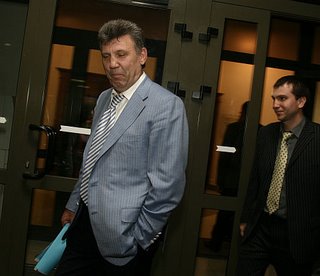
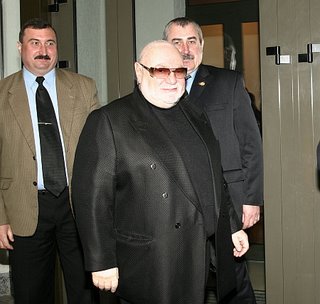
Yushchenko's dithering over the formation of a 'democratic coalition' in the VR with Tymoshenko as PM, is further eroding his support amongst the electorate. His approval rating is probably now below 15% - NSNU's is around 10%
One commentator calls the coalition negotiations an Ukrainian Rubick's cube - an apt metaphor.
February 2005 - 48.3%
April 2005 - 49.0%
August 2005 - 33.2%
October 2005 - 19.2%
January 2006 - 21.3%
April 2006 - 15.6%
[Note: In September 2005 Yushchenko sacked PM Tymoshenko and her ministers.]
The reasons given by observers for this precipitous decline are:
-Voters hopes dashed after the Orange revolution
-Yushchenko's dithering and inability to take any firm decisions
- his lack of passion for any innovation
- he prefers to delegate, rather than to tackle serious problems personally
- an inability to listen to wise council
- and his continued inability to form an effective executive
Yesterday, Party of Regions, after a meeting of their 'big-shots', [see photos from Ukr Pravda] announced they have approved a coalition agreement document which they are prepared to officially propose to NSNU. In the March 23rd Parliamentary elections, PR polled 32%, and NSNU 14%, so not totally unreasonably, PR are demanding Yanukovych be PM, and ministerial porfolios be apportioned two-and-a-half to one, in PR's favor.
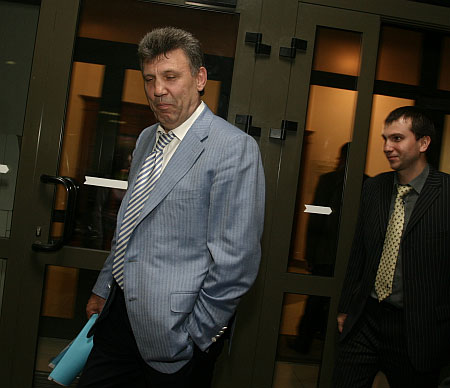

Yushchenko's dithering over the formation of a 'democratic coalition' in the VR with Tymoshenko as PM, is further eroding his support amongst the electorate. His approval rating is probably now below 15% - NSNU's is around 10%
One commentator calls the coalition negotiations an Ukrainian Rubick's cube - an apt metaphor.
Wednesday, May 17, 2006
One step forward and two steps back..
A report from today's 'Unian' website:
"Our Ukraine again suspends coalition talks
Our Ukraine has suspended the coalition talks until the Yulia Tymoshenko Bloc clarifies its stance, following Tymoshenko`s statement on the distribution of cabinet jobs. Tymoshenko said that her bloc would get the post of Prime Minister; the Socialist Party - the post of speaker; while Our Ukraine already has the post of President. Head of the Our Ukraine election team and participant in the coalition talks Roman Zvarych claimed about the suspension on Tuesday."With such mutual mistrust and with participants negotiating in what can only be described as 'bad faith,' how long can any possible 'democratic coalition' survive?
This from an article in the latest 'Dzerkalo Tyzhnya': "[Rinat] Akhmetov [Party of Regions' main sponsor and 'puppet-master'] is ready to wait half a year, [or] until the authorities come to him.."
And, "One of the most influential members of PR told 'Dz.T.' "It would be best for us to stop messing about with this president and his party, and do a deal with Tymoshenko. But she doesn't want this."
The article goes on to say that BYuT members in newly-elected city, oblast, and regional councils are already entering coalitions with other parties. If BYuT go into opposition in the Kyiv parliament, some of their members, many of whom funded the election campaign, will no-longer have any obligation to the party on whose ticket they rode into those city, oblast and regional councils.
These machinations are causing NSNU' rating to fall from 14% just over a month ago, to an almost Kuchma-like 10.4%35.3% of Ukrainians would like to see Yanukovych PM - 31.6 % favour Tymoshenko.
Tuesday, May 16, 2006
The informal economy and growth
Here's a good article on the drag the informal economy is on growth. The countries with the largest percentage are in this area of the world. I know there has been talk about enticing businesses out of the shadows and there has been some effort to streamline and lower taxes for business. And I think there has been a consensus about this across the board--at least I think there has been. But it does need to be dealt with here.
It's a wonder with all the shadow businesses around here that there are any others. But there are and they seem to compete at least on some level. The article, though, maintains that there is no incentive to invest in greater productivity on the part of these businesses. So growth is slowed or stalled. Not good for the people.
One of the problems is the perennial problem here--people with the power of government protecting these businesses because they get paid by them for that protection. This has a long tradition here extending back even to the Soviet period. (The party leaders needed stuff and protected those who could get it for them.)
It will be interesting to see what more the new government will do about this.
It's a wonder with all the shadow businesses around here that there are any others. But there are and they seem to compete at least on some level. The article, though, maintains that there is no incentive to invest in greater productivity on the part of these businesses. So growth is slowed or stalled. Not good for the people.
One of the problems is the perennial problem here--people with the power of government protecting these businesses because they get paid by them for that protection. This has a long tradition here extending back even to the Soviet period. (The party leaders needed stuff and protected those who could get it for them.)
It will be interesting to see what more the new government will do about this.
Monday, May 15, 2006
Democratic Coalition edging closer?
The possibility of a grand coalition that includes PR has decreased, according to one of their leading-lights, Vladimir Landik, deputy chairman of the Luhansk department of the Party of Regions He had been asked on a Luhansk TV channel to comment on the recent registration as VR deputies of acting PM Yuriy Yekhanurov, Secretary of Security and Defense Council Anatoliy Kinakh, and a string of other current cabinet ministers. Many of them had said previously they would not work in a Tymoshenko cabinet.
Oleksiy Ivechenko, former head of Naftohaz Ukrainy, and Valentyna Semeniuk, chair of the State Property Fund, responsible for privatizations, have also recently registered their seats in the VR.
"I think that now for sure there won't be the wide coalition. We know that Ivchenko has left, who said that he was not going to work with Yulia Tymoshenko , now Kinakh who said that he wouldn't work under Yulia Tymoshenko, and Yuri Yekhanurov might also be leaving to Verkhovna Rada. It means that everything is being done for Yulia Tymoshenko. And you are perfectly aware of our relations with her," added V. Landik.
PR polit-rada member Yevhen Kushnaryov echoed Landik's remarks, "You can always return into the government, into the Security and Defense Council, or any other executive position from the Verkhovna Rada, but to get back into VR you have to wait 5 years." He also added that PR has no wish to claim any leading positions in a democratic coalition.
The Ukrainian constitution does not allow MPs to hold executive posts, but a parliament seat provides immunity from prosecution. After the orange revolution, newly-appointed cabinet members had to give up seats in the VR, weakening the 'democratic' majority. After they had been sacked by President Yushchenko during the September 2005 crisis, there was no way back for them into parliament until the March 2006 VR elections.
The first session of the newly elected parliament will take place on 25 May. The decision was made today at a session of the working group for preparing the first session of the Verkhovna Rada of Ukraine of the fifth convocation.
Yuliya Tymoshenko considers the agreement between BYuT, NU and the Socialists in choosing the chairman for this VR working group an indication that the democratic coalition has started to work together. And a BYuT-NU-Socialist 'democratic coalition' working group has completed and created [yet another] agreement document for formation of a coalition today.
Oleksiy Ivechenko, former head of Naftohaz Ukrainy, and Valentyna Semeniuk, chair of the State Property Fund, responsible for privatizations, have also recently registered their seats in the VR.
"I think that now for sure there won't be the wide coalition. We know that Ivchenko has left, who said that he was not going to work with Yulia Tymoshenko , now Kinakh who said that he wouldn't work under Yulia Tymoshenko, and Yuri Yekhanurov might also be leaving to Verkhovna Rada. It means that everything is being done for Yulia Tymoshenko. And you are perfectly aware of our relations with her," added V. Landik.
PR polit-rada member Yevhen Kushnaryov echoed Landik's remarks, "You can always return into the government, into the Security and Defense Council, or any other executive position from the Verkhovna Rada, but to get back into VR you have to wait 5 years." He also added that PR has no wish to claim any leading positions in a democratic coalition.
The Ukrainian constitution does not allow MPs to hold executive posts, but a parliament seat provides immunity from prosecution. After the orange revolution, newly-appointed cabinet members had to give up seats in the VR, weakening the 'democratic' majority. After they had been sacked by President Yushchenko during the September 2005 crisis, there was no way back for them into parliament until the March 2006 VR elections.
The first session of the newly elected parliament will take place on 25 May. The decision was made today at a session of the working group for preparing the first session of the Verkhovna Rada of Ukraine of the fifth convocation.
Yuliya Tymoshenko considers the agreement between BYuT, NU and the Socialists in choosing the chairman for this VR working group an indication that the democratic coalition has started to work together. And a BYuT-NU-Socialist 'democratic coalition' working group has completed and created [yet another] agreement document for formation of a coalition today.
The eccentric mayor
Here's some more on what the mayor of Kiev is looking to do. More populism? Sometimes the mayor makes a lot of sense and sometimes he sounds crack-brained. Which one is he really? I don't know, but government owned stores selling to the poor and the elderly--really the same thing here--makes a certain sense. This one, at least, isn't crack-brained. The poor here are just going to get poorer and going to be in a lot more jeopardy than they were what with the rise in energy prices which is going on apace. But it just won't work. It will just create some more Mercedes and BMW drivers because it will increase opportunities for graft and corruption.
"So, just have some kind of agency oversee what goes on in these stores. Make an example of a few of the people who engage in this kind of corruption and that will end it." Won't happen. Just cut the members of the agency in on a piece of the action and the way is paved for your grand dacha in the protected portions of the wilderness.
It will create great expense and it will poorly serve the poor. It will bust the budget and leave some guys in tailored suits and slick, pointed shoes, smiling. In other words, it will be more of the same.
"So, just have some kind of agency oversee what goes on in these stores. Make an example of a few of the people who engage in this kind of corruption and that will end it." Won't happen. Just cut the members of the agency in on a piece of the action and the way is paved for your grand dacha in the protected portions of the wilderness.
It will create great expense and it will poorly serve the poor. It will bust the budget and leave some guys in tailored suits and slick, pointed shoes, smiling. In other words, it will be more of the same.
Some coalition commentary
Here's some more commentary on coalition maneuvering that summarizes what LEvko has been pointing out for a couple of weeks. If it comes down to dissolving Parliament and calling for new elections, I think that Our Ukraine will be the loser. They just won't show up to vote.
Will that mean Yuschenko won't do it? No, he might just do it anyway. It could be that he is operating on some kind of principle and dissolving Parliament might be consistent with that principle. This is just to say that anything might happen.
Will that mean Yuschenko won't do it? No, he might just do it anyway. It could be that he is operating on some kind of principle and dissolving Parliament might be consistent with that principle. This is just to say that anything might happen.
Chernovetski's church
Here's something on the church Kiev's mayor belongs to. Not anything strange for America but it is a different thing for here.
The charismatic movement has landed, looks like.
The charismatic movement has landed, looks like.
Friday, May 12, 2006
Yushchenko interview
Polish newspaper 'Gazeta Wyborcza,' whose exemplary reporting of the Orange Revolution and after was second to none, today published an interview with President Yushchenko - He probably feels more relaxed talking with 'G.W's' journalists than with those in Ukraine, so his replies were candid and revealing.
When asked whether Ukraine's path to integration with the European Union was still a subject of dispute, he replied that this was no longer the case. "30% of our exports today go to EU markets - 5 years ago it was barely 18%. Ukrainian businesses have already voted with their feet for a European direction for the country. We are conviced that the large European market is opening for us - but it is also a challenge...We are not confronted with a choice as to which way we are to go - East or West - but with the task of fulfilling conditions, necessary for integration," he added.
In reply to a question whether he would agree to Yuliya Tymoshenko becoming PM again, he quoted the results of the OP about which I blogged a couple of days ago - perhaps indicating that he takes account of OP's too. [I wonder what his own current ratings are]. He states unequivocally, "An Orange Coalition is the best possibility," and "..[the possibility] of an orange-blue coalition is excluded for today."
And would he agree to Tymoshenko occupying the PM's position? "I do not exclude this. But the most important task is to find a formula for a stable coalition. I especially do not allow discussions on allocation of [governmental] posts...without determination of goal[s], discussions on [ministerial] portfolios will bury the orange coalition." He should read Tammy Lynch's excellent piece on the recent German coalition-building process, and why personnel decisions have to be sorted out first.
Partiya Regioniv are complaining that 'nobody likes them no more'. They blame BYuT, the NU bloc, and Socialists' representatives for frustrating the working group preparing formalities for the first session of the newly-elected VR.
The orange parties' representatives failed to turn up for the first meeting of the working group, then their representatives were unprepared for subsequent meetings, which ended without any progress being made. PR appeal to their fellow committee members to work constructively and to act in a professional manner. They consider that representatives of NU, Socialists and BYuT are putting at risk the opening of the first VR session scheduled for 24th May. [Maybe because they are incapable of sorting out an Orange coalition before that date?]
When asked whether Ukraine's path to integration with the European Union was still a subject of dispute, he replied that this was no longer the case. "30% of our exports today go to EU markets - 5 years ago it was barely 18%. Ukrainian businesses have already voted with their feet for a European direction for the country. We are conviced that the large European market is opening for us - but it is also a challenge...We are not confronted with a choice as to which way we are to go - East or West - but with the task of fulfilling conditions, necessary for integration," he added.
In reply to a question whether he would agree to Yuliya Tymoshenko becoming PM again, he quoted the results of the OP about which I blogged a couple of days ago - perhaps indicating that he takes account of OP's too. [I wonder what his own current ratings are]. He states unequivocally, "An Orange Coalition is the best possibility," and "..[the possibility] of an orange-blue coalition is excluded for today."
And would he agree to Tymoshenko occupying the PM's position? "I do not exclude this. But the most important task is to find a formula for a stable coalition. I especially do not allow discussions on allocation of [governmental] posts...without determination of goal[s], discussions on [ministerial] portfolios will bury the orange coalition." He should read Tammy Lynch's excellent piece on the recent German coalition-building process, and why personnel decisions have to be sorted out first.
Partiya Regioniv are complaining that 'nobody likes them no more'. They blame BYuT, the NU bloc, and Socialists' representatives for frustrating the working group preparing formalities for the first session of the newly-elected VR.
The orange parties' representatives failed to turn up for the first meeting of the working group, then their representatives were unprepared for subsequent meetings, which ended without any progress being made. PR appeal to their fellow committee members to work constructively and to act in a professional manner. They consider that representatives of NU, Socialists and BYuT are putting at risk the opening of the first VR session scheduled for 24th May. [Maybe because they are incapable of sorting out an Orange coalition before that date?]
Wednesday, May 10, 2006
Coalition-building drags on..
The latest OP indicates 35% of Ukrainians would like to see Yanukovych PM, while 32% would like to see Tymoshenko in that position. Yekhanurov comes in a weak third at 7%.
47% of those questioned would favour a BYuT-NSNU-Socialist coalition, while 38% a RU-NSNU coalition - the former possibility, significantly, being supported by 36% of NSNU supporters.
One of the problems with all of this coalition-building is that leading members in both NSNU and the Socialist party are not 'singing from the same hymn sheet'. Yesterday veteran Socialist leader Oleksandr Moroz admitted that his party may be included in a Grand coalition with NSNU and PR. And yet today Yosyp Vinskiy, head of the Socialist polit-rada, says that entry of his party into coalition with PR is not permissable.
Although the Socialists garnered less than 6% of the votes in the elections, they have a pivotal role to play, and are under a deal of pressure to join a grand coalition. If they did so, BYuT would be left out in the cold [with the Communists]. For Moroz it would be a last chance to get his hands onto the levers of power rather than go into opposition with BYuT.
It's generally accepted that NSNU #1 Yekhanurov is keen on a grand coalition, but other leading members of his party, eg Zvarych and Bezsmertniy are far less enthusiastic. I've written in past about some waverers in RU, but now Yanukovych has stamped his authority on his party again, and has probably brought them back into line - and he wants the PM's job.
There are even rumors that several members of BYuT would rather 'jump ship' and join a grand coalition than go into opposition. Many newly elected deputies paid large sums of money 'up front' for a favourable place on party lists. They didn't pay to go into opposition.
Meanwhile President Yushchenko ostensibly declared last week that he is not a participant in coalition negotiations, and that formation of a coalition is solely the responsibility of the newly-elected political blocs entering parliament.
Today Communist leader Petro Symonenko, whose party is the smallest to 'scrape' into the VR, prognosticates that a grand coalition will eventually be formed between PR and NSNU [and possibly Socialists]. The coalition will be dominated by business structures, with Yekhanurov remaining PM, and the remainder of the cabinet dominated by PR.
Whoever forms the ruling coalition, most observers agree that the new government will continue to progress on Ukraine's path to Europe. As ex-Economics minister Seghiy Teryokhin says in an an interview today, "The top managers in PR are [now] used to living by the rules of European life - they want stability and certainty for the future."
My own hunch is that if PR were driven into opposition, then the fissures that must exist in that party would open up too.
47% of those questioned would favour a BYuT-NSNU-Socialist coalition, while 38% a RU-NSNU coalition - the former possibility, significantly, being supported by 36% of NSNU supporters.
One of the problems with all of this coalition-building is that leading members in both NSNU and the Socialist party are not 'singing from the same hymn sheet'. Yesterday veteran Socialist leader Oleksandr Moroz admitted that his party may be included in a Grand coalition with NSNU and PR. And yet today Yosyp Vinskiy, head of the Socialist polit-rada, says that entry of his party into coalition with PR is not permissable.
Although the Socialists garnered less than 6% of the votes in the elections, they have a pivotal role to play, and are under a deal of pressure to join a grand coalition. If they did so, BYuT would be left out in the cold [with the Communists]. For Moroz it would be a last chance to get his hands onto the levers of power rather than go into opposition with BYuT.
It's generally accepted that NSNU #1 Yekhanurov is keen on a grand coalition, but other leading members of his party, eg Zvarych and Bezsmertniy are far less enthusiastic. I've written in past about some waverers in RU, but now Yanukovych has stamped his authority on his party again, and has probably brought them back into line - and he wants the PM's job.
There are even rumors that several members of BYuT would rather 'jump ship' and join a grand coalition than go into opposition. Many newly elected deputies paid large sums of money 'up front' for a favourable place on party lists. They didn't pay to go into opposition.
Meanwhile President Yushchenko ostensibly declared last week that he is not a participant in coalition negotiations, and that formation of a coalition is solely the responsibility of the newly-elected political blocs entering parliament.
Today Communist leader Petro Symonenko, whose party is the smallest to 'scrape' into the VR, prognosticates that a grand coalition will eventually be formed between PR and NSNU [and possibly Socialists]. The coalition will be dominated by business structures, with Yekhanurov remaining PM, and the remainder of the cabinet dominated by PR.
Whoever forms the ruling coalition, most observers agree that the new government will continue to progress on Ukraine's path to Europe. As ex-Economics minister Seghiy Teryokhin says in an an interview today, "The top managers in PR are [now] used to living by the rules of European life - they want stability and certainty for the future."
My own hunch is that if PR were driven into opposition, then the fissures that must exist in that party would open up too.
Tuesday, May 09, 2006
A Ukraine energy plan
This is news to me, but it looks like Ukraine has an energy plan. The shock produced by Gazprom in January must have shaken some people awake.
The kicker? Same old, same old:
That should read "poorly audited, unprofitable and corrupt" to make the point clear. Those three travel together.
But if they have gotten as far along already as they have with outside contractors, such as Alfa Laval AB, working to solve problems, it does look like some attitudes have changed. Things don't usually happen that fast. Maybe January and the Kremlin sobered the right people up. Let's hope so.
Gazprom's price move was seen here as Moscow's revenge for Ukraine's so-called Orange Revolution, which led to the election of a Western-friendly government in 2004. Gazprom, in which the Russian government holds a controlling stake, denies any political motivation. But the effect has been that Ukraine, which has a population of 50 million, has quickly produced a program to reduce gas consumption. It has set up a new energy-efficiency agency to direct the plan and is pouring government money into efforts to carry it out.
"My inbox is filled with letters from metals and chemicals companies asking for help in cutting their energy use," says Yevgen Sukhin, the new agency's chief.
The kicker? Same old, same old:
There are big obstacles to carrying out all of Ukraine's plans. Financing can be hard to get where companies and local authorities are poorly audited, often unprofitable and often corrupt. Ukraine's political instability has consistently undermined government plans. "We've had a lot of broken promises," says Stanislav Potapenko, program coordinator in Ukraine for a nonprofit organization called Alliance to Save Energy, though he says attitudes are changing.
That should read "poorly audited, unprofitable and corrupt" to make the point clear. Those three travel together.
But if they have gotten as far along already as they have with outside contractors, such as Alfa Laval AB, working to solve problems, it does look like some attitudes have changed. Things don't usually happen that fast. Maybe January and the Kremlin sobered the right people up. Let's hope so.
Report on Free Trade between the EU and Ukraine
A hefty report [248 pages, available as a free pdf file download] entitled:
"The Prospect of Deep Free Trade between the European Union and Ukraine," by the Centre for European Policy Studies, has recently been published.
A quote from the intro:
"The Prospect of Deep Free Trade between the European Union and Ukraine," by the Centre for European Policy Studies, has recently been published.
A quote from the intro:
Date Published April 2006"This study examines the feasibility, content and likely economic impact of a free trade agreement between the EU and Ukraine. A simple and shallow free trade agreement, adding only the elimination of tariffs on trade in goods to the conditions for WTO accession, is the most easily feasible option, but would yield only modest benefits for Ukraine and less still for the EU.
By contrast, a deep free trade agreement (or ‘FTA+’) with the EU, while posing more difficult issues of feasibility, could be a centrepiece of an economic strategy leading Ukraine into rapid growth. An FTA+ with the EU would entail an extensive, yet still selective, alignment of Ukraine’s external and internal market laws and standards with those of the EU. Politically, this step would be consistent with Ukraine’s ‘European choice’.
The country has little or no chance of becoming a prosperous economy and society without openness and integration into the European and global economy, alongside compliance with normal standards of advanced economic governance at home. Not being a natural resource-based economy, Ukraine has no choice but to develop a competitive and diversified economy centred primarily on industrial and service sectors. This point is underlined by the increase in the price of imported energy since the start of 2006.
Nevertheless, there is evidence suggesting that the combination of economic openness, convergence on modern European and international standards of economic regulation and corporate governance and proximity to EU markets could lead to a sustainable high growth path for Ukraine.
The country’s economic paradigm could change drastically, with a re-branding of its reputation and with its industry entering into the European and global supply chain. Such a strategy would also be of value to the EU economy in meeting the challenges of globalisation and Asian competition."
Monday, May 08, 2006
Holidays
Last week, we had May Day and that was two days off which maybe got stretched to a little more than that just to accommodate the festivities. This week, it's victory in the Great Patriotic War and we have another two days off for that, which may get stretched a little bit more again.
The one this week is a big one, though. It was a cause celebre in the Soviet Union. If there was nothing else to recommend it, at least they could always point, with a lot of reason, to the victory over the fascists as a reason. So we celebrate.
It is an interesting thing to be in an audience, have the speaker congratulate all the veterans of the war as he has them stand up and see only women standing. It was a bit jarring to me to see it. But that is the fact here. The home front was the front and everyone was in it.
We know a woman who was in her twenties during the war and saw the Nazis roll into her little village. The stories she tells are riveting. When they left, a lot left with them, the portion that is, that wasn't destroyed. And over 90% of the men in that village died during the war so there were a lot of widows. Those widows are the veterans left there.
The one this week is a big one, though. It was a cause celebre in the Soviet Union. If there was nothing else to recommend it, at least they could always point, with a lot of reason, to the victory over the fascists as a reason. So we celebrate.
It is an interesting thing to be in an audience, have the speaker congratulate all the veterans of the war as he has them stand up and see only women standing. It was a bit jarring to me to see it. But that is the fact here. The home front was the front and everyone was in it.
We know a woman who was in her twenties during the war and saw the Nazis roll into her little village. The stories she tells are riveting. When they left, a lot left with them, the portion that is, that wasn't destroyed. And over 90% of the men in that village died during the war so there were a lot of widows. Those widows are the veterans left there.
Saturday, May 06, 2006
Alternative suppliers of gas?
National Security & Defense Coucil Secretary Anatoliy Kinakh, in an interview in today's 'Ekonomicheskie Ivestiya', says Ukraine intends to start discussions on the supply of gas from Russia with alternative companies other than gas behemoth Gazprom.
"We're talking of a more liberal gas market. In particular, one of our discussion strategies is obtaining access to independent suppliers to the gas transport system, formation of a natural gas market, and creation of a gas exchange," he said.
"There's a lot of companies that wish to supply us with gas at quite attractive prices. Lukoil, TNK, and string of other structures. We're talking of tens of billions of cubic metres," he added.
Kinakh explained that according to Russian law, the many regions in which gas is extracted are also owners of a portion of this gas, and stated, "When we contact the authorities in these regions directly, we become convinced of their readiness to supply gas. The problem, which should be decided at governmental level, is their access to the Russian gas transport system, in particular the ratification by Russia of the European Energy Charter."
Gazprom deputy chief executive Alexandr Medvedev stated recently that Russia is not interested in ratifying the EU Energy charter which would allow third-party access to the Gazprom's pipeline network.
Kinakh also mentioned the need to solve problems of limited throughput capability of the 'Central Asia - Center' pipeline, which is vital for supplying Ukraine with Turkmen gas, and about which I have blogged previously.
President Niyazov of Turkmenistan is to visit Ukraine in the near future when"not only gas relations for the next half-year are to be determined, but also long-term agreements with Turkmenistan are to be signed.
Are Kinakh's remarks just a small part of a co-ordinated effort to break Gazprom's monopolistic grip of Russia's gas transportation system? It's going to be a big struggle..
"We're talking of a more liberal gas market. In particular, one of our discussion strategies is obtaining access to independent suppliers to the gas transport system, formation of a natural gas market, and creation of a gas exchange," he said.
"There's a lot of companies that wish to supply us with gas at quite attractive prices. Lukoil, TNK, and string of other structures. We're talking of tens of billions of cubic metres," he added.
Kinakh explained that according to Russian law, the many regions in which gas is extracted are also owners of a portion of this gas, and stated, "When we contact the authorities in these regions directly, we become convinced of their readiness to supply gas. The problem, which should be decided at governmental level, is their access to the Russian gas transport system, in particular the ratification by Russia of the European Energy Charter."
Gazprom deputy chief executive Alexandr Medvedev stated recently that Russia is not interested in ratifying the EU Energy charter which would allow third-party access to the Gazprom's pipeline network.
Kinakh also mentioned the need to solve problems of limited throughput capability of the 'Central Asia - Center' pipeline, which is vital for supplying Ukraine with Turkmen gas, and about which I have blogged previously.
President Niyazov of Turkmenistan is to visit Ukraine in the near future when"not only gas relations for the next half-year are to be determined, but also long-term agreements with Turkmenistan are to be signed.
Are Kinakh's remarks just a small part of a co-ordinated effort to break Gazprom's monopolistic grip of Russia's gas transportation system? It's going to be a big struggle..
Friday, May 05, 2006
Impulses from the Prez?
On Friday Yushchenko is to meet the leaders of the political forces which will make up the new Parliament - Tymoshenko, Moroz, Yekhanurov, Yanukovych and Symonenko. He promised to apply maximum effort, in order that the process of formation of a [ruling] coalition "receives a new impulse, and is completed in the nearest one or two weeks."
He had previously spoken of a coalition being formed by the last weeks in June. Whether this new 'impulse' is in response to Tymoshenko's and Moroz's joint letter which was submitted yesterday, is unclear. [see yesterday's blog]
Yushchenko's made his remarks in Vilnius, while attending the "Common Vision For A Common Neighborhood” conference together with the 'great and good,' including Javier Solana, Dick Cheney, and heads of state of neighbouring countries. Has someone been whispering in his ear?
Meanwhile Head of PR political council, the odious Mykola Azarov who some say is an old pal of Poroshenko, announced that it has sent their version of a coalition agreement to all of the parliamentary parties. My impression is that since the elections their heart has not really been into this 'coalition-building' thing. The problem is who do they speak to? There is no chance of them dealing with BYuT. And as for NSNU, well Bezsmertny and Zvarych say its too late for deals, and yet Poroshenko and Yekhanurov are offering different messages.
He had previously spoken of a coalition being formed by the last weeks in June. Whether this new 'impulse' is in response to Tymoshenko's and Moroz's joint letter which was submitted yesterday, is unclear. [see yesterday's blog]
Yushchenko's made his remarks in Vilnius, while attending the "Common Vision For A Common Neighborhood” conference together with the 'great and good,' including Javier Solana, Dick Cheney, and heads of state of neighbouring countries. Has someone been whispering in his ear?
Meanwhile Head of PR political council, the odious Mykola Azarov who some say is an old pal of Poroshenko, announced that it has sent their version of a coalition agreement to all of the parliamentary parties. My impression is that since the elections their heart has not really been into this 'coalition-building' thing. The problem is who do they speak to? There is no chance of them dealing with BYuT. And as for NSNU, well Bezsmertny and Zvarych say its too late for deals, and yet Poroshenko and Yekhanurov are offering different messages.
Wednesday, May 03, 2006
Yushchenko's foot-dragging..
Taras Kuzio, in a recent article "Oligarchs into Businessmen: Ukraine’s Transition to the Post-Kuchma Era" [in Egle Ridzeviciute ed., Contemporary Change in Ukraine. Baltic and East European Studies 5 (Stockholm: Baltic and East European Graduate School, Sodertorns Hogskola, 2006), pp.10-34] writes the following when describing the build-up to the 2004 Presidential elections:
Contrast this with some quotes on Naftogaz, the Ukrainian state-owned gas company from the recent GlobalWitness report:
"Those within the pro-presidential camp were evolving from oligarchs to businessmen understood the need for change.It seems, then, that Ukraine's most powerful businessmen, many of who also 'pull the strings' in its political parties, are changing the way their businesses are run, for the better. [I have written previously about 'Oxford-trained MBA's' working for Akhmetov]
A 'critical mass' of businessmen would like to operate in a 'normal' legal environment where the success or failure of their businesses will not be dependent on their faithfulness to the president. These former oligarchs, eg Pinchuk, maintain good relations with Yushchenko. Pinchuk and the Donbas clan are also legitimizing their business interests by inviting international auditing firms to place their business empires on a legal and transparent footing."
Contrast this with some quotes on Naftogaz, the Ukrainian state-owned gas company from the recent GlobalWitness report:
"..hair-raising practices of Naftogaz under Yuriy Boyko, its chairman from 2002 to 2005.
Despite persistent questions about the intermediary companies, against a backdrop of public concerns about official corruption and organized crime in the countries of the former Soviet Union, there has never been sustained, thorough and high-level oversight of these companies, and the structures and people involved in them.
..critics might question Yushchenko's political will to confront Kuchma's legacy of opaque and unaccountable business practices.Ukraine needs clear reforms to promote open and accountable management of its gas industry...Without reforms, the transit of gas to Ukraine will continue to be a highly politicised, opaque and unstable business"
President Yushchenko and his administration are lagging behind public opinion and treating the Ukrainian electorate with contempt. They are also lagging behind Ukraine's big businessmen.
ps Yuliya Tymoshenko and Socialist leader Oleksandr Moroz today proposed a meeting to discuss coalition-building with President Yushchenko, in a jointly written letter. They suggest they all meet before 5th May. A source from the President's administration says, however, "There has been no official documentary appeal to the Secretariat." More foot-dragging..
Kryvorizhstal--the next instalment of the story
Here's something on what's happening with Kryvorizhstal, now Mittal Steel, now. It will be interesting to see how that works out.
These are telling figures though:
And each employee's total benefits cost around $5000. That means a total cost of $285,000,000? Is that possible?
These are telling figures though:
Kryvorizhstal employs 57,000 people. With the average worker supporting a family of four, 228,000 people depend on the plant.
And each employee's total benefits cost around $5000. That means a total cost of $285,000,000? Is that possible?
Monday, May 01, 2006
Ukraine's economy
Here's a good article on Ukraine's economy from a historical perspective. If true, his claim that the economy is only 63% of the economy of 1990, the pre-independence economy, ought to sober people up a lot.
Better is a relative term. Things might be better now but compared to what?
I can say that things here have improved a lot since I came here in 2002. More buying power, more products to chose from are both a lot better. In fact, Ukraine is the third fastest growing retail market in the world. From where it started, however, just about any growth at any rate would make it that. And again better than what? Than they were? Than they might have been?
There have been lots of opportunity to make things different here. There are still lots of opportunities to do that. We can only hope that these opportunities won't be squandered.
Better is a relative term. Things might be better now but compared to what?
I can say that things here have improved a lot since I came here in 2002. More buying power, more products to chose from are both a lot better. In fact, Ukraine is the third fastest growing retail market in the world. From where it started, however, just about any growth at any rate would make it that. And again better than what? Than they were? Than they might have been?
There have been lots of opportunity to make things different here. There are still lots of opportunities to do that. We can only hope that these opportunities won't be squandered.
Subscribe to:
Posts (Atom)