Thursday, June 22, 2006

Refreshed orange?

Well it looks like the Oranges are back in business - but the partners still don't trust one another. Socialist leader Oleksandr Moroz says that if the deal is not 'closed' Thursday, all bets are off and his party becomes a free agent again. NSNU's Bezsmertniy wanted to delay until Friday..

And Petro Poroshenko, Tymoshenko's biggest enemy in NSNU, is to be nominated for the VR speaker's job. She accused him may times of sabotaging her work when she was PM - they loathe one another.

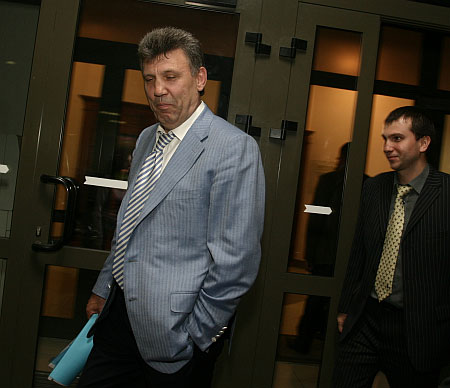
Now Anatoliy Kinakh, a former PM whose Party of Industrialists and Entrepreneurs of Ukraine forms a portion of NSNU, also wants the speaker's job. Although he has been critical of Tymoshenko in the past, his appointment in the VR would be more acceptable to Tymoshenko. When Tymoshenko was returning to her seat after addressing the VR today, Kinakh gave her the 'thumbs-up' as if to say, 'Good speech, Yulka..' [Photo from 'Ukrainska Pravda']

There is a sober realization by all partners that it's going to be really tough to hold things together, even for a few months. There wasn't really much 'fizz' amongst the orange deputies in the VR today despite the ostensibly successful agreement between its leaders.

Wednesday, June 21, 2006

Ukrainian roulette?

The realization that a grand parliamentary coalition is now likely has spurred deputies in Western Ukrainian, strongly pro-Yushchenko oblasts and cities to issue statements that they are 'deeply disturbed about the general direction of the country's development' and do not accept 'unnatural political alliances'.

They say that they 'will not allow the trust of the nation, so forcibly demonstrated at the Maidan, to be broken'.

I thought the air of resignation in both Socialist leader Oleksandr Moroz's, and Yuliya Tymoshenko's rather sarcastic address to parliament [VR] today gave the impression that they consider 'the game is up' in their talks with NSNU - whatever they agree to, NSNU then keep 'moving the goalposts'. NSNU leaders, many of whom form their business wing, are determined to assemble a 'grand coalition' - NSNU's Roman Bezsmertnyi called it a 'stabilization coalition' today.

According to the rules, the successfully assembled coalition proposes for approval to the president their nomination for PM, and those ministers that are nominated by parliament. At first sight it would appear that any coalition must be formed by fractions who together make up a majority, because as I wrote earlier, 'changing horses' midstream is not permitted. However it seems that there is some 'wriggle room' - if a VR deputy does not leave his faction voluntarily, but is expelled, he still retains his voting mandate on an 'individual basis'. I guess there are party organizers 'phoning around possible defectors, making up lists of deputies, and adding up the numbers right now.

If a ruling coalition is not formed by the 25th June, the president has the power, but is not bound, to call for fresh elections.

A few weeks ago Yushchenko controversially stated that he would refuse to approve the Verkhovna Rada's Prime-Minister nomination until the VR attests the judges of the Constitutional Court. [Just another minor complication maybe everyone's forgotten about.]

Yanukovych has declared that if by tomorrow a parliamentary majority is not formed, his party will initiate a motion to elect a VR speaker and is counting on the votes of 'conscientious politicians' to form an 'anti-crisis' coalition. He says they have enough votes [with defectors from other parties] to do this. Lots more 'fun and games' in prospect..NSNU as a political force could be in deep trouble..

Just as I am finishing writing, this piece below has popped up on 'Ukrainska Pravda':

UKRAINE HAS A NEW PRIME MINISTER , 21.06.2006, 00:06

During the meeting with [President] Viktor Yushchenko, final office sharing issues, which were a stumbling block for the creation of the Orange team, were settled.This information was reported to Ukrayinska Pravda (UP) by an informed source.
This means that the creation of a coalition including BYuT, “Our Ukraine”, and the Socialist party (SPU), would be announced in the Parliament on Wednesday.

The roulette wheel is slowing down. But where will the little ball land - on red or on black? On orange, or on blue?

Tuesday, June 20, 2006

Less than three years ago...

"On 31st October 2003 the Our Ukraine bloc led by Viktor Yushchenko failed to hold a congress of democratic forces in Donetsk as planned. After arriving in Donetsk that day, Yushchenko and his supporters were confronted by hostile crowds at the airport and in downtown Donetsk in what looked like a highly coordinated effort to prevent the Our Ukraine gathering and to fan anti-Yushchenko sentiment in the city.

The entire city was adorned with billboards showing Yushchenko in a Nazi uniform extending his hand in a Nazi salute and calling for the "purity of the nation." Some 1,500 mainly young and drunk people filled the planned venue and effectively prevented Our Ukraine from holding the congress. Neither the police nor officers of the Security Service did anything to stop them.

According to many Ukrainian publications, including the "Ukrayinska pravda" website and the "Grani" weekly, the plan of "countermeasures" against Yushchenko in Donetsk was coordinated by Donetsk Oblast Council head Borys Kolesnykov, Donetsk Oblast Governor Anatoliy Bliznyuk, and Donetsk Oblast Deputy Governor Vasyl Dzharta. The entire "anti-Yushchenko operation" was also allegedly supported by Rinat Akhmetov, Ukraine's richest oligarch, whom many call the "real boss" of Donetsk and the backbone of the Donetsk clan."

Yushchenko and his supporters were 'run out of town' - just like in the wild-west.

A detailed report of what happened which includes the quotes above, is here.

Today Kolesnykov is at #10 on PRU's list of parliamentary deputies, and is also one of PRU's chief negotiators in current NSNU-PRU coalition talks.
Dzharty is #22 on PRU's list of parliamentary deputies.
Akhmetov is at 'lucky' #7 on PRU's list of parliamentary deputies.

Sunday, June 18, 2006

Sooner or later, PRU 'on the up'

Presently it is, apparently, 'consulations' on parliamentary {VR} coalition that are taking place between NSNU and PRU. While at the same time, 'negotiations' are proceeding between the leaders of three orange parties BYuT, NSNU, and SPU.

This maybe indicate that an orange coalition is still the more likely. The process has to be 'done and dusted' by 25th June, otherwise the President has the power to dissolve parliament and call for fresh elections. He is, however, unlikely to do this because his own party's ratings, [NSNU] have declined even further since the March elections, and there is a realistic possibility that Yanukovych's PRU could gain an absolute majority in any follow-up elections, some observers claiming NSNU's vote could drop to 5%.

Alternatively, a short-term 'pseudo-coalition' could be formed to temporarily save the President from the humiliation of dissolving the VR.

Or acting PM Yuriy Yekhanurov and his cabinet could continue 'limping on' for some time. But without a functioning parliament, the country would remain in a state of political stasis.

Today SPU leader Oleksandr Moroz issued a strongly worded rebuttal, challenging accusations made by President Yushchenko on Friday when he berated Moroz for demanding the position of VR speaker for himself.

He complains, "Appointments at all levels [of government] over the last year and a half have taken place according to the canons of the previous government, and not according to professional principles. This is evidenced by the woeful state of affairs, e.g. in the oil and gas sphere, and in most sectors of the law-enforcement systems*."

And his statement closes, "I again must sadly note that the 'ideals of the Maidan', which were shown to be close to the Ukrainian nation, have not yet become the leading principle of action for the new authorities. Most people in the government still don't understand that Ukrainians succeeded in gathering together [at the Maidan], in order, in the words of a classic, 'to kill the dragon inside.' If the authorities do not come to their senses, the citizens will not suffer quietly for another 10 years." Much undisguised bitterness in the orange camp then, with little sign of rapprochement.

Even at this late stage, it's 50:50 as to which coalition combination will be realized..

The time wasted by the orange forces has benefitted PRU. They know that any orange coalition is unlikely to hold together for long, so sooner or later their moment will come. And, bolstered by disenchanted defectors, a coalition led by themselves would probably be more robust and stable.

PRU claim that some deputies defecting from other parties have secretly pledged them their support, so they have the numbers already, but because of rather unclear rules forbidding deputies to 'change horses in mid-stream', they cannot submit their candidate to be voted into office in the VR. Officially, if a deputy switches from one fraction to another, he supposedly automatically forfeits his mandate.

*Last September Yushchenko fired PM Yuliya Tymoshenko and her entire cabinet, sensationally blowing apart the orange coalition brought together for the 2004 Presidential elections, after her #2, Oleksandr Turchynov, who was head of the Ukrainian Security Service [SBU] at the time, was close to exposing corruption involving persons close to the President, in the field of gas procurement. They had allegedly continued running scams previously operated by members of the Kuchma regime. I have blogged previously about the current state of the SBU.

Monday update: NSNU have completed their 'consultations' with PRU and are ready to proceed with 'negotiations', according to one of NSNU's top negotiators, Roman Zvarych.

When asked to comment about progress between the three orange coalition partners, he replied, "There are differences which are sufficiently serious that they could become a barrier." But he did go on to say that if discussions start with PRU, then certain differences could arise, particulary concerning questions of NATO and [Russian] language [status].

Saturday, June 17, 2006

NSNU and PR tango

It looks like it's going to be NSNU and PR. At least all the signs point that way. The heads of NSNU and PR have been ensconced away in negotiations today and there appears to be some movement on the NATO thing, at least if one senior member of PR can be believed. ("Our people will probably forget NATO, but they won't forget wages and pensions...")

I don't know how Our Ukraine is figuring this. Any uniting with PR will be seen as a complete abandonment of Maidan--maybe even a repudiation. "They spit in the faces of teh people who stood on the Maidan" would be the feeling. And they will suffer politically from it. That seems clear. But five years is a long time in politics and maybe they feel the people will forget that little side trip and who knows? If things shape up, maybe people will. The problem is that it will take a lot of will for things to shape up because that means reform and taking on corruption. It is hard for me to see that that is a part of the PR platform and it is looking like it is not on the agenda of some parties in Our Ukraine either.

Or do they think they can remain in power other ways? If that is true, the Orange Revolution will have purchased nothing. It will have been a brief interlude on the way to getting back to business as usual. I hope this isn't the case. Kuchma is beginning to look pretty good, though.

The real irony is that a NSNU/PR coalition will make Ukraine look more stable to the outside, that is, to investors and others. That can be a good thing but only if there is the kind of reform I don't think this crowd is seriously considering. I hope I'm wrong, but it would mean a guy like Yanukovych and his crowd suddenly seeing that the way they have done business in the past is either wrong, morally, or that it doesn't get them what they want. I don't see them finding religion on that issue at all and doing business the way they do it always gets them what they want.

The one problem it does solve is to enfranchise one half of the country. It will bring east Ukraine into the government. And that isn't a bad idea. The problem is at what cost and will there be any effective bridging of the divide? On the second, I don't think this is on anyone's agenda either. And the cost looks like it might be too high.

By the way, this might be one reason why Yuschenko is distancing himself from NSNU. Do they believe he is the head of the party? I don't believe they think they owe him anything. As a matter of fact, he might have been a drag on the party in the elections from their point of view. So are they really listening to him anyway? He preserves some credibility by distancing himself.

It is interesting that someone paint-bombed NSNU's headquarters today. The color of the paint? Blue. That is political speech, no?

Thursday, June 15, 2006

Aimless drifting..

Yushchenko's NSNU say they will sign a coalition agreement with Party of Regions of Ukraine as long as three conditions are met :


  • PRU reject federalism
  • PRU reject decisions providing Russian language regional status
  • PRU reject the assertion that Ukraine is 'NATO-free territory'
An NSNU source says bilateral "consultations" are taking place, but considers "calling them negotiations, [is] simply laughable." However, the source considers the positions of PRU and the Socialist Party of Ukraine 'very close'.

In the March parliamentary elections PRU received more than twice the number of votes than NSNU, and have 186 deputies to NSNU's 81. Surely it is PRU that should be dictating the terms, not NSNU? The Russian language issue in particular was a big plank in PRU's election campaign, and they really 'played up' the recent business with NATO troops in Crimea to embarrass Yushchenko, so there's a huge gap to bridge over before an NSNU-PRU deal can be agreed.

The tone of resignation in yesterday's addresses by Yuliya Tymoshenko and Oleksandr Moroz to parliament seemed to indicate that they considered their lengthy negotiations with NSNU were at an end. But President Yushchenko today still claimed he supports the creation of a democratic orange coalition. "The political forces that were victorious in democratic elections should carry out their mission and find mutual understanding within the framework of negotiations on formation of a coalition," he told journalists.

He added, that although he was not a participant in negotiations, "I shall do everything that needs to be done, in order that a democratic coalition takes place in Ukraine."

More of this on pressa's website in English here.

Does anyone really know anymore what he really wants or in what direction he is heading?

Wednesday, June 14, 2006

Events moving quickly now..

NSNU have not negotiating in good faith and are not interested in any orange parliamentary coalition. They have 'put a little cross on it', as they say in Ukraine. Socialist leader Oleksandr Moroz today made a big sacrifice and backed down from his long-standing demand to be proposed VR speaker, proposing only that all leading positions, from deputy of regional administrations to Prosecutor General, be distributed proportionally between the three orange coalition members .

But Anatoliy Kinakh, on behalf of NSNU, says this is still not acceptable. They are looking for 'new partners' which can only mean Yanukovych's PR, to join a grand coalition - something Yekhanurov and some others from NSNU, particularly its 'business wing' wanted from the start.

Even though NSNU have been exposed as a bunch of 'time-wasters', do they really believe that PR, the largest bloc in the new VR, who have now started a serious 'general mobilization', are going to play second fiddle to them and the President?

PR leading member Raisa Bohatyrova claimed yesterday that already 25 members from the orange forces have defected and will support PR. So, together with the Communists, they already have 231 out of 450 parliamentary votes 'in the bag', she gloated. They feel they now have the 'momentum'.

One pro-NSNU newspaper, sourcing Stanislav Byelkovsky quoted in a Latvian periodical, claims Tymoshenko is doing 'behind the scenes' deals with PR financial sponsor and VR deputy, Rinat Akhmetov. In exchange for supporting Tymoshenko's candidature for PM, Akhmetov would be allowed to add Ukraine's largest telecom company, Ukrtelekom [one of the last juicy morsels left for privatization] to his business empire. Although some NSNU deputies would not support Tymoshenko's candidature for PM, possibly 30 - 35 PR deputies would, claims Byelkovsky.

This may be just a 'spoiler', but I suspect there may be a lot of this kind of desparate jockeying by newly-elected deputies, and 'buying off' of votes going on, but ultimately PR will demand the lion's share of the top jobs in any grand coalition. Will NSNU and the President be prepared for the eventual humiliation? Amazingly, it seems that having Tymoshenko PM and Moroz VR speaker would have been an even more unpalatable scenario for them. It's like watching a train crash in slow motion..

I wonder if Yekhnurov and the rest of the NSNU negotiators will 'mess' PRU about as much a they did BYuT and the Socialists.

VR, meeting today for the first time in a while, have 'clocked off' early too, to watch events from WMschaft in Germany. A good result will put everyone in a better frame of mind.

Will they do it?

I have been busy, busy, busy with some deadlines that I am up against. But LEvko, as always, has kept everyone updated on the latest information about forming the government--or not forming it. Everyone is waiting to see what will happen. But with the indications we have right now, it doesn't look so good.

Our Ukraine says it is now free to find another coalition partner. The only other parties out there are the communists with their just over 3% and Party of the Regions. So which one do you think they mean?

If they don't form a government, Yuschenko will have to dissolve Parliament and that means new elections. If that happens, Our Ukraine will be sunk. Three things can happen at this point if they re-vote and all of them are bad. People will either stay home because they're fed up with it all, which favors the parties with true believers, BYuT and PR; or they will show up and vote for some other party because their fed up with it all; or they will show up and punish Our Ukraine-- because they are fed up with it all. The point is that people are fed up with it all. And they are mostly fed up with Our Ukraine. So they had better avoid a new vote.

Why won't there be a fourth option, a groundswell of support for Our Ukraine if there's a vote? Because people are fed up with it all.

Tuesday, June 13, 2006

Moroz comments on Coalition crisis

BBC Ukrainian service interviewed Oleksandr Moroz today after NSNU's decision to abandon further discussions on creation of an Orange parliamentary coalition, blaming the Socialists for the impasse.

Highlights:

"Notice that for a month the entire battle hinged on NSNU's inability to agree to Yuliya Tymoshenko's candidature for the position of PM. Now they say that a coalition cannot be worked out because of the Socialists. In truth, it's not about me or the Socialists. It's because they [NSNU] cannot agree amongst themselves."

"Everything will be realized for the benefit of persons from business structures who call themselves supporters of NSNU, and who have for long been conducting negotiations with PR with the aim of creating a coalition without us [Socialists], without BYuT, and so on.

Then he throws down a challenge: "Go ahead create it, [ a PR-NSNU coalition] don't make a secret of it..

When asked how will he act if the democratic coalition talks end in failure, [in this case is the expression 'democratic alliance' an oxymoron?] he replies, "We will go into opposition."

When asked how he rated the chances of an orange coalition being created, compared with a coalition formed by PR and only part of the orange forces, he replies, "I think 50 - 50".

Saturday, June 10, 2006

'Wheels dropping off' Orange Coalition?

The NSNU press secretary stated today that the "coalition negotiations [between BYuT, NSNU and Socialists] have ceased." The stumbling block has been Moroz's nomination for VR speaker - NSNU are demanding this position is filled by one of their own people.

In a subsequent press conference Tymoshenko appealed to NSNU to resume talks, adding, "Those political forces which toppled the orange coalition the first time round, are toppling it for a second time right now."

She told journalists, without naming names, that "big money" lies behind this development, and that the impasse over VR speaker nomination, "is just an pre-planned excuse, in order to form a coalition having a different format."

When asked if this means that NSNU have been staging coalition talks with PR, she said, "I am convinced that a parallel process has gone on."

In today's radio address President Yushchenko washed his hands of the entire matter. "I consider that a politician who lays claim to the position of PM, should take responsibility for creation of the coalition...this is [normal] European practice."

He explained that he is not interfering int the process of coalition building because, "he does not want the coalition to be formed under pressure," and agreed that "BYuT who obtained 22% of the votes should choose the position of PM or VR speaker, NSNU, who obtained 14%, 'bagsies*' the second position, and the SPU 'bagsies' the third position.

So Tymoshenko has to sort out the mess - if the 'wheels drop off' the democratic coalition, it will be her fault. Not for the first time she will be 'nevistka' - daughter-in-law. [According to a Ukrainian saying, all domestic family problems and disputes are blamed on 'nevistka'.]
*see previous post.

Monday Update: [From Ukrainska Pravda]

OUR UKRAINE REJECTED THE COALITION
translated by Eugene Ivantsov , 12.06.2006, 12:55

Our Ukraine believes coalition with BYuT and SPU has no future, says Our Ukraine statement presented by its press service on Monday.
"Because of categorical statements made by SPU regarding speaker’s office Our Ukraine considers further negotiations unpromising," says the statement.
"Our Ukraine is sorry for the personal ambitions of SPU leader ruined negotiations."
"We believe such step is irresponsible to the people of Ukraine," reads the statement.

Coalition negotiations frozen by Moroz ..

So its out in the open - Yuriy Yekhanurov, NSNU's main negotiator, admitted today that the formation of the democratic coalition has stalled because the Socialists, the third largest participant in the coalition, insist their leader, Oleksandr Moroz be allocated the VR speaker's job.

As the second-largest participant in the democratic coalition, NSNU's first pick was for the VR speaker position too.

The largest participant, BYuT naturally bagsied* the PM's job.

They are all meeting tomorrow at noon to decide what to do. "The Socialists have driven the negotiations into dead end,"complained Yekhanurov.

*Bags. verb, often used by English children. To claim as one's own due to being the first to make such a claim. E.g."Bags I go first," or "We bagsy Crimea."{Informal}

Wednesday, June 07, 2006

Unforeseen finale to Coalition formation?

Today President Yushchenko was in Holland on an official visit - he enjoys trips abroad where receptions are friendly. Meanwhile, back at home, the Ukrainian Parliament [VR] announced another adjournment , this time to 14th June. Our Ukraine, BYuT, and SPU voted together to carry the motion, by the thinnest of majorities - 227 out of 435 deputies present.

The President, at a press conference in the Hague advised the parties trying to form the democratic coalition, to consider results of the March 26th elections when discussing allocation of government posts, which has been the main obstacle so far and main reason for delay in forming a coalition. “This would be the best way to show they respect the will of the people, as well as the best principle to share posts in the government and parliament..I think this principle has been disregarded.” Yushchenko often makes rather vague and verbose comments such as these, but maybe it's as close as he will get to saying he would agree to Tymoshenko being PM.

He had a meeting the day before with the top players forming the democratic coalition - Yuriy Yekhanurov, Roman Bezsmertny, Yulia Tymoshenko and Oleksandr Moroz, and they "managed to bridge many of differences,” he added.

Interesting piece in 'Ukr Pravda' today which says the main stumbling block preventing formation of the democratic coalition seems to be the Socialists' demands that their leader Oleksandr Moroz be appointed VR speaker.

His party are 'digging in' for this nomination - but NSNU insist on a 'counterweight' to Yuliya T for this position.' Moroz apparently is under great pressure from his party to demand the speaker's job [his last chance to achieve a high position in government]. They are telling Moroz they are indifferent in which coalition he is to gain this position ..

Article ends, "The feeling arises, that the dragging out of the process may lead to an unforeseen finale. As everyone is aware, the closure of the VR session greatly insulted the Party of Regions, who again remain outside of the process. It cannot be excluded that PR & the Communists, who are already arranging a meeting of deputies under the name of 'Stability in Ukraine', are organizing a transfer of parliament to the 'Ukrainskyi Dim'. Then there will be two alternatives: either PR will agitate or 'buy-off' a few deputies for their own majority, and form the govt. they want, or President Yushchenko, in order to avoid a velvet revolution in parliament, will have to cobble together a broad coalition with all of the predicted consequences."

It is absolutely obvious that results of the March 26th elections should be considered - now, even the President has said it.

Note: The new VR comprises PR 186, Communists 21, Socialists 33, BYuT 129, NSNU 81 Putting PR & KPU together provides 207 votes - 19 short of an absolute majority. If some of the Socialists were tempted or 'bought off,' some BYuT deputies would probably cross over too.

The 'Stability in Ukraine' group is a new inter-fractional group with 37 deputies from all five policial forces entering parliament, at the moment. According to Anatoliy Kinakh, the members are highly qualified leaders of top enterprises. Kinakh says that it is not an alternative to VR majority..."[but that] its work will be directed, so that on the basis of constructive co-operation with the president, coalition govt, to form rules of game for development of the economy."

Are they thugs?

One commenter here suggests that I implied the protestors in Crimea were thugs and criminals by suggesting they might have gone on a looting spree.

That was all tongue and cheek. How could "dozens" of people, instead of hundreds or thousands as in Paris, go on a looting spree? And when they ran out of songs? Did they sing any? That is a phenomenon of the US, gather around to protest and sing about overcoming or no more this or that.

I posted it that way because it was funny to me the idea of "dozens" of Ukrainians linking their arms around the port (how do "dozens" do that effectively) then going on a looting spree when they ran out of songs. That is a funny thing to me and still is. And I would think with the kind of sense of humor Ukrainians have, it would be funny to them too.

In any event, I might post something else here that is funny to me. I could label it but I probably won't. Just so you know.

Tuesday, June 06, 2006

Soccer and politics

So the likelyhood that PRU will form part of the government coalition is receding.

Anti-NATO demonstrations in Crimea, and the elevation in some eastern oblasts and cities of the Russian language to the status of regional language are dominating the news. And in Moscow there's been renewed talk of Crimea being returned to Russia.

Is it naive to consider these matters are connected?

Is this a new strategy by PRU to seize power in the country by some kind of coup d'etat, or as a last resort, a forced splitting of Ukraine, as one observer suggests?

In the next few days Ukraine's bid to win soccer's World Cup in Germany, arguably the biggest sporting event in the world, begins. For the first time Ukraine qualified for the finals, and has several world-class players, so could do well.

Russia has failed to qualify.

Ukrainians across the country, both in the east and the west, whatever their political affiliations, will be 'glued' to their televisions, cheering on their national team.

Over many decades, it has been clear that success in this tournament by a country's nation team, has had a marked influence on the economy and 'feel-good' factor of that country.

E.g. West Germany's success and victory in the 1954 finals provided a historical turning point, helping restore that country's prestige after WW2. Victory for the England team playing at home in the 1966 finals, was a major factor helping the then government, which basked in the reflected glory of its national team, to be re-elected at the next general elections.

Sporting events in Germany over the next few weeks, apart from diverting attention from serious problems and challenges at home, will have an influence events in Ukraine. Success will be a boost for the President. However, success has many fathers, failure is an orphan..

Sensational revelations about SBU..

Last September Oleksandr Turchynov resigned as head of the Ukrainian Security Services, [SBU] on the day PM Yuliya Tyomoshenko and her cabinet had been sacked by President Yushchenko. He was quickly replaced by Ihor Drizhchanyi who promised, when introduced by Yushchenko, to 'spare no effort' to make the Security Service a modern, efficient body, which will serve the nation's interests.

Turchynov, in a press conference following his resignation, said he had been closing in on persons close to President Yushchenko linked to corruption in the gas industry, but was told to 'back off' by Yushchenko himself.

A few days ago, on 1st June, "Ukrayina Moloda" a Ukrainian daily edited by presidential adviser Mykhaylo Doroshenko, published a sensational article "Ihor Drizhchanyi leases out Security Service of Ukraine to serve the Clans and Moscow".

A quote: "Athough it is unpleasant to admit, but after the victory of Maidan democracy the SBU has gradually slid away from state control. But worse, in such a situation, clans and even [those from] abroad are striving to control Volodymyrska St, [SBU headquarters] and not state officials." The article state that by those from abroad they clearly mean 'Moscow'.

[There is a summary in the current AUR #706 here, but the original lengthy original article is well worth reading because the revelations are so startling.]

Just one revelation: The current 'gray cardinal' in the SBU, Volodymyr Radchenko, who headed the SBU in the days of Kuchma and is now an adviser to Drizhchanyi, allegedly sold a portion of land adjacent the SBU main building in Kyiv to 'king of Donbas' Rinat Akhmetov to provide the Donbas elite with luxury penthouses and apartments. Some in the Donbas-based PRU wanted Radchenko as their candidate in the 2004 Presidential elections - a 'Ukrainian Putin', rather than twice-jailed Yanukovych.

Because the breadth and seriousness of the allegations in the article are so great, and 'Ukraina Moloda' so close to the President, this story will 'run and run'.

ps Check out British 'Independent' here for story on the business in Feodosiya/

Sunday, June 04, 2006

Arrogant Putin

In a recent press conference, Vladimir Putin replied in the following manner to a question by a German press agency chief who asked him about deteriorating relations in the sphere of energy supplies between the Russian Federation and its partners, and also about Russia's refusing western countries access to its gas deposits:

"Our western friends supported the Orange events in Ukraine. That which is going on all of this time, we can can [all] see brilliantly - there's lots of problems. If you support that which is going on there, then you will have to pay [for it]. Why should we pay?"

"Why should German consumers pay $250 for Th.c.m. of gas, when in Ukraine they pay $50? If you want to make gifts, then pay for them. Why should we pay?"

Not very statesmanlike comments considering last March's Parliamentary elections were considered by everyone as being the fairest in Ukraine's history -totally free of foreign interference.

From 1985 to 1990 the KGB stationed Putin in Dresden, East Germany, in what he himself acknowledges was a minor position.

ps Not much reaction to events in Feodosiya by parties forming the 'democratic coalition, so far. NATO must be a dirty word in Ukraine.

Saturday, June 03, 2006

Chernomyrdin weighs in

Just when I said it was about money, I find that the Russian ambassador to Ukraine says it about geopolitics. So which is it?

Probably both.

Kremlin at it again? A turning worm

Is the Kremlin raising gas prices as of July 1st to prevent the ascension of Yulia to the premiership? That is one of the explanations for why Moscow is raising the gas price right now asserted in an article from RFE/RL. I suppose the argument is that if Yulia is PM she'll tear up the agreement made in January, which she has said she will do and that is not good for the Kremlin. But will raising the price of gas prevent that from happening?

The argument would have to go something like this: We'll raise the price on them to show them we can do it any time we want to. Knowing that, they will be careful not to choose someone who'll just make us want to do it again. That means no Yulia.

That doesn't follow too well to be even the kind of thinking the Kremlin might come up with.

I think we're beyond that sort of thing. They are raising the price because they can do it. Are they looking for anything in return like pressuring Ukraine to return to the fold? I don't think so. I think it's a question now of maximizing profits. Gazprom is looking to make a public offering and I think they are wanting to make it look as good as they can. It's simply a question of profitability and money and the fact that they can get it by raising the rates. And Ukraine has been so ham-handed at any kind of response I think the Kremlin thinks it can weather any kind of criticism that might come of it. And they very well might be able to. We'll see.

Putin has to keep two sets of people happy, the clans in the Kremlin and the people. He keeps the clans happy by giving them businesses. He keeps the people happy by keeping the economy humming and maintaining stability. Gazprom is crony run and may be the place Putin ends up after he leaves office. Making sure it's doing well benefits the cronies and the economy (and may ensure it is a real power base for his use later.) That means one stone for helping to keep two birds happy--or something like that.

The price of natural gas has gone up 50% for residential uses. There has been some reaction but not much. But that is a real signficant rise in the price. And raising the price further might mean real economic problems ahead. And it will mean hardship for a number of people.

A lot of people here cannot afford to live as things stand now. If the cost of living goes up because of the rise in price of natural gas, that might just push these people over the edge. What will they do then?

Thursday, June 01, 2006

Russia, Crimea and NATO

The State Duma of the Russian Federation intends to ask the government about the possibility of Crimea being returned to Russia. Several days ago a majority of Duma’s members backed the corresponding protocol message to the Duma Committees on the International Affairs and CIS.

Even the Communist Party of Ukraine have condemned this move. Russia's periodic trouble-making over Crimea is counter-productive and mainly for domestic consumption.

korrespondent.net conducted [an admittedly non scientific] straw poll recently, asking readers: 'How should Ukraine react to the State Duma's wish to take back Crimea?' Out of 679 votes cast, only 2.8% said return Crimea; 35% said take back former Kievan Rus' lands, and 22% said apply all efforts, up to the use of military action; 17% said use diplomatic efforts to maintain Ukraine's integrity; and 12% said take no notice.

It's about time Putin made his position clear on this matter, preferably before the G8 summit.

Meanwhile Party of Regions have indicated that they are not anti-NATO, and want "to do the same as Russia, i.e. without direct entry into NATO, to seriously deepen Ukraine's co-operation [with the alliance]; but membership would have to be decided only after a referendum on the matter," according to PR press service, quoting Taras Chornovil, one of the party's 'leading lights'. The referendum could take place, "no sooner than in two or three year's time." These statements have maybe been timed to cover embarrassment over the demonstrations against the US vessel in Feodosiya recently, about which Scott has recently written. A majority of Ukrainians are against full NATO membership at the moment.


Update:
Update: Today the Russian State Duma has retracted questions about possible union between Crimea and Russia. It was all a mistake and a misunderstanding, according to Chairman of the interparliamentary Committee for co-operation between Federal assemblies and the Ukrainian VR Konstyantin Zatulin.

Anti-NATO demonstrations

There were some demonstrations in the Crimea a few days back when an American naval ship moored at a port down there to drop off some supplies for a NATO exercise to be held somewhere around that area. These demonstrations were filled with anti-NATO protestors and they were large enough to make the national news.

How large were they? "Dozens" of demonstrators participated. Dozens? Soudns kind of sparse doesn't it? Yet it made teh national news. Couldn't have been more than a couple of dozen people there to sings songs of freedom and overcoming and linking arms to surround that symbol of , what? Western expansionism? Yet yet it made the national news. Sounds like what passes for an unbiased view of what is newsworthy at US news outlets.

I'm surprised they didn't go on a looting spree after they ran out of songs.

There's something about it here.

The mayor and apartments

It has been noted in the press here that Chernovetsky has given up his mayor’s paycheck for it to be used to buy apartments for Kiev citizens who don’t have them. That’s a nice gesture though it will probably not amount to much given the rise in apartment prices here in the past couple of years. I don’t think the mayor gets paid all that much relatively speaking so it will be a drop in the bucket.

The other problem is that there are over 100,000 people on the government’s list to get apartments. A couple of years back we went down to the local government agency that dealt with that in the area where we lived then and saw the list. It was in the lobby, that is, the hallway leading off from the front door. (There are no lobbies here in government buildings, just hallways.) I don’t know how many names were on that list but it stretched along a long wall. There were probably a couple of thousand names on it.

But the thing we saw that didn’t look promising was that some of them had been on that list since the 1960s. This is not a good sign. It is likely that they have been passed over by other, (cough) better connected apartment-less people, but that still isn’t a good sign.

Chernovetsky says that some of those on these lists are not there legitimately. And he might be right. But in one of his weekly town hall meetings in the front of the city council building on Kreschatyk downtown a couple of weeks ago, there were a large number of people there asking for help. The number one request: Get me an apartment.

One woman at that meeting said she is living in a one room apartment with her son and his family. That puts her in the kitchen. She told Chernovetsky she sleeps in the kitchen and he, seeing that she was an older woman, suggested that she could be taken to a senior center. There were places there. It may have seemed to him a reasonable thing to say—it does solve a problem-- but it sounded heartless.

It was after that meeting that he said he would forgo his mayor’s salary so that it could be used to buy apartments. Maybe the scope of the problem sunk in afterward. But it may take his Praveks Bank earnings to make any real dent in it.

Wednesday, May 31, 2006

Don't hold your breath..

When visiting Donetsk on Tuesday 30th May, President Yushchenko, at a press conference, stated, "The law provides 30 days from the first sitting of the Verkhovna Rada for a coalition to be formed. So on the 29th day I will pose the question to the forces which are forming the coalition. At the moment they [their discussions?] are solely in the constitutional field." He added, "I am convinced that we all understand that the matter of a coalition of orange forces, which would have a majority of [only] 17, is delicate and brittle."

Yushchenko's recent assertive declarations, will also complicate and delay formation of any coalition. In particular, democratic coalition partner Oleksandr Moroz won't be too happy by some of the President's ideas on the Constitution - he was always keen on reform; and there is not much there to indicate that the President is more amenable to Yuliya Tymoshenko becoming PM.

Looks like it's going to go 'to the wire'.

Yushchenko gets tough..

In his regular radio address last Saturday, President Victor Yushchenko controversially stated that he would refuse to approve the Verkhovna Rada's Prime-Minister nomination until the VR attests the judges of the Constitutional Court.

Last December, Monitoring Committee of the Council of Europe Parliamentary Assembly (PACE) urged the Ukrainian Parliament to carry out its constitutional duty and renew the composition of the Constitutional Court of Ukraine without any further delay. [Some good further info in this particular link]

One of the reasons for the VR's foot-dragging was that it did not want the Constitutional court to assess the validity or otherwise of Law № 2222-VI on amendments to the Constitution of Ukraine, December 8, 2004, which the VR approved at that time. This law came about after negotiations between Kuchma, Yushchenko, and intermediaries, and was considered a 'trade-off', enabling the repeat of the second round Presidential elections to take place just after the Orange Revolution.

The law, which came into effect 1st January 2006, reduced the powers of incoming President Yushchenko, compared to those of his predecessor, Kuchma.

In December 2005, the Ukrainian National Commission on Democracy and Rule of Law had come to the conclusion that the Law № 2222-VI should be regarded as 'nullum ab initio', and therefore not be considered as the element of the current Ukrainian Constitution, according to a press release by Ukraine's Ministry of Justice .

As things stand at present, the President is the only state authority that can attempt to sort out the mess, and this perhaps explains Yushchenko's uncharacteristically forthright declaration last Saturday. He wants to regain those lost Presidential powers.

Monday, May 29, 2006

Language issues

Following the recent legally dubious granting, by their regional councils, of regional language status to the Russian language in Donetsk and other Eastern Ukrainian regions , the Donetsk 'novosti' website conducted a straw poll on this issue.

When local respondents were asked if the granting of regional status to the Russian language would improve the prosperity of their families, 95% said No.

When asked if they considered that the work of the city economy would improve, once Russian is granted regional language status, 99% said No.

When asked for whom they thought that life would get better once Russian is granted regional language status, 89% replied, Nobody.

And 91% considered that none of the city's problems would be solved by the recent declarations in the Donetsk city council on enhancement of the status of the Russian language and on Ukraine's ties with NATO.

As in many matters, Ukraine's politicians are sometimes behind their citizens in their thinking. The language issue is periodically 'wheeled out' to challenge the authorities in Kyiv and probe the government's weakness. Everybody knows that central government is far too weak to make any changes on the ground in the regions on these matters, even if it wanted to.

Most enlightened Russian-speaking Ukrainian politicians are aware that it is smart to have some knowledge of spoken Ukrainian. Kuchma, and Yanukovych made an effort to learn passable Ukrainian. Yulia Tymoshenko on entering politics, spoke little Ukrainian, but now, in public, this is usually her language of choice, even though BYuT tend to avoid taking a firm line on this delicate issue.

Even the King of Donbas, Rinat Akhmetov, on being elected to to the Ukrainian parliament, last month promised to learn Ukrainian, calling his own inability to speak the language a shortcoming. And in the recent VR elections, the party that took the most vociferous line on the language issue, Nataliya Vitrenko's Progressive Socialist Party, performed worse than expected, and narrowly failed to breach the 3% barrier.

Note: In comprehensive surveys conducted in 1997, 44% of Ukrainians said Russian was their language of preference, 41% said Ukrainian, while 14% were equally happy in either language. [From Andrew Wilson's 'The Ukrainians: Unexpected Nation'.]

Friday, May 26, 2006

The currency

I'm not a finance guy so I don't pretend to know everything about currency and currency markets but if a country has to defend it's peg to the dollar and uses $1.7 billion to do it, it is hard for me to understand how that same currency can be considered undervalued. But that is what the Ukrainian National Bank did in the first quarter, use $1.7 billion to defend the hyrvna.

But experts are still saying that the hyrvna is undervalued and that a correction is in the offing in the fall. I assume they mean a correction which strengthens the hryvna against the dollar. Which again raises the same question: if the hryvna is strong why then did the central bank have to intervene to defend it?

Any thinking on this would be welcome.

Thursday, May 25, 2006

First day back in VR

The Verkhovna Rada of the fifth convocation, which was elected on March 26, gathered for its first session in Kyiv today. Newly elected deputies took an oath of office and the text of the oath was read out by the oldest parliamentarian, Ivan Herasymov from the Communist Party.

The initial festive atmosphere soon turned sour. [some nice photos here and here including this one below: My caption - Yanukovych is saying, "I'm not going to hurt you....yet..]

The formation of an Orange coalition seems to have taken a major step forward. The deputies of NSNU, BYuT, and the Socialists all voted together [an impressive 240 votes] to adjourn the VR until 7th June.

PRU and Communist deputies tried to block the dais and prevent the vote taking place, or at least call for a 'time-out' to discuss the matter further, and the usual verbal 'custard pie fight' ensued.

About 60 of their deputies surrounded the acting [Socialist] speaker's chair, but their attempt to halt proceedings failed. Maybe the tactics of which I wrote a few days ago are paying off already.

The orange fractions say is that they need the two-week break to form their coalition.

Later, in a press-conference Yuliya Tymoshenko castigated PRU for their behaviour, which included mass stamping of feet, whistling and shouting. "I want to say this is not a soccer ground, it is not a 'Shakhtar vs Dynamo' game, so I ask deputies to be civilized and tolerant," she said.
Before the Orange revolution, the then-opposition used similar tactics too. Once, while she was addressing the VR and saw the PRU deputies had entered the chamber wearing blue and white scarves which they waved to taunt her, she sneered at them, "I'm pleased you all have your scarves - something to hang yourself on when you lose the elections.."

Rinat Akhmetov, Ukraine's richest businessman and PRU 'banker', on his first day as a Ukrainian VR deputy was quoted as saying, "If there are going to be any fights in Parliament, I want to remind everyone I was a boxer for 7 years.." [And what else..?]

PIRANHA!

We heard a news report earlier in the week that they had found piranha in one of the lakes here in Ukraine. I thought it one of those types of reports that show up periodically that are long on sensationalism but short on facts. My problem with it was how a tropical fish could survive the harsh winter here. So I dismissed it.

Turns out I was wrong. Looks like they found a few in a Kasianka Lake in eastern Ukraine. I guess they can survive the harsh winters because it looked like they did here.

So now I have a pressing question to pose: has anybody looked into whether there are crocodiles in the sewers of Kiev yet?

Incentives and population decline

There has been some interesting debate in the US about population decline spurred by Putin's state of the union address. (One example is here.) In that address he offered financial incentives to get women to have children. The point for Russia is that it's in demographic freefall; they're losing 700,000 a year. Ukraine is in the same boat per capita though it has a smaller population. But the same factors are at work here.

I can tell you though that the program here to get women to have more children has been a bust. The incentive was 8000 hyrvna last year, or about $1600. Thats a pretty good sum for Ukraine. It's about 8 months pay on average.

But that 8000 hryvna only succeeded in raising the birthrate by a half of one percent. That doesn't sound like much of an increase. The budgeteers may be happy with this but the demographers may not be.

Wednesday, May 24, 2006

Ukrainians favour Orange Coalition

Almost 40% of Ukrainians support an 'orange' coalition, according to an OP conducted by the Razumkov Center. Amongst the residents of Western and Central regions, the figure is over 50%.

Residents in Eastern Ukraine favour a PR-NSNU coalition. Of all Ukrainians questioned, 17.4% support this arrangement, and 13.2% support a grand coalition. The latter figure is interesting, and possibly indicates BYuT's rising popularity in the east.

Almost a quarter did not express a preference.

Almost 55% of those questioned consider there was no hindrance to their casting their vote. Almost 10% claim there were significant obstacles

These results are broadly in line with previous OP's where fewer respondents failed to express a preference.

In the March Parliamentary elections, PR received 32%, BYuT 22%, NSNU 14%, Socialists 6%, and Communists just over 3%, of votes cast.

Tomorrow is 'first day at school' for many of the newly-elected deputies.

"The Ukrainian parliament gathers for its inaugural session on May 25. President Viktor Yushchenko is expected to attend the session and make a speech. Under the amended Ukrainian Constitution that took effect on January 1, 2006, the president has the right to dissolve parliament if it fails to form a majority within 30 days after its first sitting or to form a new cabinet within 60 days after the dismissal or resignation of the previous one."

[From http://www.rferl.org/newsline/3-cee.asp]

Tuesday, May 23, 2006

Seating arrangements in VR

The seating arrangements in the newly-elected Parliamentary deputies have been agreed, and the first sitting of the new Verkhovna Rada is to take place on Thursday.

Yesterday BYuT, NSNU, and the Socialists had decided on one possible seating arrangement, but this morning the Socialists wanted to change it, for reasons that provide some insight into the workings of the VR.

The Socialists were to be seated in a narrow wedge of seats in twos and threes, behind one another, but this would have made it more difficult for one of their deputies [a so-called 'piano-player] to vote, by pressing a panel button in front of each seat, on behalf of other, absent deputies, in the short period of time allotted for voting. This kind of officially impermissible behaviour has frequenly taken place in the past.

The Socialists will now sit in a group either side of the central aisle, giving them strategic 'control' of this all-important passageway. The workings of the VR are often disrupted by deputies storming and blocking the central dais. The Socialist deputies alone should now be able to block the central aisle and make staging of such charges and blocking by disgruntled deputies more difficult.

PR will dominate the left hand side of the VR, giving them easy access, via the nearest exit to an empty lobby, where they can quickly plot 'off-the-cuff' strategy without journalists, who normally linger in the opposite lobby, being present.

But the best seats, to the right of the speaker, are retained by NSNU - this is an area most favoured by TV and mass media cameras. The government ministers' lobby is nearby, and so this location is a parliamentary action 'hot-spot'.
From Ukrainska Pravda]

It's the culture, stupid

The title of this post is taken from the phrase the Clinton election team kept in front of its face in the election of 1992. The stupid was added to bring home the fact that the economy was the only thing that mattered in that election. So "it's the economy, stupid" was the theme.

One of the points I have been trying to make here from the start is that it is a mistake to generalize across cultures. That is a tendency on the part of Americans and it has gotten us in some trouble in Iraq and in other places (including in business, I might add.) But generalize we do.

The reason for this is that generalizing about human beings is a part of our culture. We will argue to the heavens, though, that it's not a cultural matter but a rational one. I get this all the time and have had a tough time with students when I raise that issue in the cross-cultural courses I teach. But it is a fact; Americans generalize about human beings because it is a part of our culture to do that. "All men are created equal" is an expression of this. The idea expressed by all pols no matter where they are found along the political spectrum that all people want liberty is another example of this.

But the fact is that people are different and the cultures that set the limits about what is acceptable from them, are all different too. And we need to understand that if we are going to be of any use in trying to solve the problems of the world. From my perspective, though, very few consultants, even the high powered types they fly in to staff these country programs, understand this. They figure if you tinker with the system and get it perfectly balanced, all fine tuned, then you can fly home with another successful country program under your belt and post your resume for the next challenge. But that is a typical American response. Why do they do that? Because it works in America. The problem is that it does not work in other cultures.

An example: They fly in consultants into this part of the world to help get the country humming along democratically. What they end up doing mostly, is writing laws and setting rules and procedures for it all. And what is the result? A nice, pretty new collection of laws of the country but no real change in the way the country does it's business.

The big problem here is corruption and it is a cultural problem, not a legal problem. Everyone points to that nasty little man Kuchma and talks about how bad he was while they go to the premiere school in the area and pay $300 to the principal to get their little dear enrolled. All understood by everyone, all accepted and acceptable, and all perfectly illegal under the law. But Kuchma is the bad guy.

What is going to change that kind of thing? Passing more laws?

Milton Friedman the acclaimed economist once said that he got it wrong in Russia. He had said, "Privatize, privatize, privatize." But he understood that was wrong now. Instead it should have been, "Rule of law, rule of law, rule of law." Well, he's still got it wrong. It is "Culture, culture, culture." And that is a beast of a different order of magnitude.

Here's a quote from Orwell that expresses the point: "Till recently it was thought proper to pretend that human beings are very much alike, but in fact anyone able to use his eyes knows that the average of human behaviour differs from country to country. Things that could happen in one country could not happen in another." It still is proper and in the US, rational to think this way.

And seeing what is before our eyes is an important thing to do if we are going to be useful at all. We in this little blog have tried to do that.

Yuschenko Jr., the Orange Revolution and Peru

It is possible the brat son of Yuschenko is taking advantage of his name and not of some behind the scenes calls from daddy. The risk that something might happen because you nabbed the top man's son would outweigh most anything else even if the top man doesn't call. That means a pass for junior. People are habituated to that kind of influence here. It seems to be in the cultural DNA. So the risk of it can be the fact of it. At least I hope that's what it is.

But if dad is running interference for junior that should be made public and Yuschenko take his lumps for it. The problem is that it is not only junior that does it. Anybody with connections or money will do the same thing. Life is cheap here and any consequences for risking it or taking it can disappear through the magic of money or of the right contacts. Get to the right person and pay the right fee and it will be as though it never happened. Kind of like what you might expect from a capitalist version of 1984.

I was going to post a link to the article below over a year ago--January 5th, 2005 to be exact-- to serve as a cautionary tale for Yuschenko. (We have done this quite a bit here on Foreign Notes. A lot of the posts have been with the idea that maybe they could avoid making some mistakes that were obviously in waiting. Not much luck though, I'm afraid.) I didn't then but now seems like a good time. There are some similarities between the two presidents and situations. Reading too much into it might not be helpful, but there could be something to be learned from the similarities.

Anyway, here it is: Peru President's Kin Create Headaches.

Monday, May 22, 2006

Andriy Yush in hot water..again.

According to an article in the normally-staid 'Korespondent', President Yushchenko's spoiled brat of a son, Andriy, is in 'hot water' again.

Last Friday evening his BMW was pulled up by the Boryspil prosecutor, Oleksandr Kuzovkin, after Andriy's 'beemer' had overtaken him and 'carved him up'. The occupants of both automobiles got out of their vehicles and Kuzovkin, having recognized the young Yushchenko, announced who he was. After Kuzovkin explained that the 'beemer' was being driven recklessly and that an accident may have been the result, Andriy verbally abused, and then assaulted him. For good measure, Andriy Y's bodyguard shot Kuzovkin in the thigh with a rubber bullet, and they left him wounded, lying in the road.

The 'Korespondent' article says, 'Andriy Yushchenko promised the prosecutor in a course manner, that tomorrow he would be sitting in prison, and subjected to humiliation of a sexual nature.' [Very coy..]

The police consider the incident to be 'of an everyday nature, [well that's all right then] and Yushchenko's press office has asked people not to jump to conclusions, but wait for an official statement from law-enforcement officials.

There have been rumors over many months that Yushchenko, like his predecessor, sometimes cannot resist, and solves problems by 'phoning and 'leaning' on people when required. The Ukrainian media will be watching closely - if Andriy receives any preferential treatment [which he probably will,] this, hopefully, will be exposed. These stories are doing great damage to the President's prestige..but hey, does he really care? Last time Andriy made a fool of himself, the Pres. called the journalist from 'Ukrainska Pravda', who ran the story, 'a hired killer.'

Now the prosecutor-general's office has announced that amongst the materials in the case of bodily harm rendered to the Borispil procurator, 'there is no information on the President's son's involvement in any of these incidents'.

Tymoshenko's support in Eastern Ukraine

In the March 26th Ukrainian Parliamentary elections, the final declared results in the Donetsk Region were PRU 74%, Vitrenko bloc 7%, Socialists 4%, Communists 3%. BYuT 2.4% NSNU 1.4%

A recent OP, published on the 'Novosti Donetska' website, reveals that now, two months after polling, almost 20% of Donetsk oblast residents would be ready to support Tymoshenko as PM. Interesting..

Of the Orange leaders, she would be the most acceptable to those in the eastern Ukraine, if their man Yanukovych were not to be PM.

ByuT had complained that there had been some shady arithmetic during the ballot counts following the March elections, in the Easternmost oblasts.

Friday, May 19, 2006

Chernovetsky and the teachers

We know someone who is a teacher in the Kiev district. She tells us that Chernovetsky has taken away the bonus that Omelchenko gave them for some reason. She says he's anti-teacher but I don't think she really knows why. We don't know why either.

Apparently, Omelchenko raised their pay 10% in a kind of cost-of-living raise. Then he added another 10% as a sort of bonus. All of this was an attempt to raise their pay, which is abysmal by any standards. But according to her, Chernovetsky has taken that away.

Some of these teachers supplement there meager wages with offers--demands, really--to tutor the children outside of class. That will give the student a leg up, something implied if not stated, and so the bribe is paid. But our experience is that these are not usually the best teachers anyway.

There has been an outflight to some extent of teachers to other jobs in the economy. And that has left a lot of mediocre to bad ones. There are some excellent teachers still there but they aren't there for the pay but for the love of it. But Ukraine cannot afford to lose the good ones. They can kiss the rest goodbye if they cannot educate their children adequately.

When we get more on this, we'll post more.

Thursday, May 18, 2006

Yushchenko's decline..

In a periodically repeated opinion poll, conducted over the last two years, when respondents were asked, "Do you support the actions of Viktor Yushchenko?" the following percentages responded: 'Support them fully.'

February 2005 - 48.3%
April 2005 - 49.0%
August 2005 - 33.2%
October 2005 - 19.2%
January 2006 - 21.3%
April 2006 - 15.6%

[Note: In September 2005 Yushchenko sacked PM Tymoshenko and her ministers.]

The reasons given by observers for this precipitous decline are:
-Voters hopes dashed after the Orange revolution
-Yushchenko's dithering and inability to take any firm decisions
- his lack of passion for any innovation
- he prefers to delegate, rather than to tackle serious problems personally
- an inability to listen to wise council
- and his continued inability to form an effective executive

Yesterday, Party of Regions, after a meeting of their 'big-shots', [see photos from Ukr Pravda] announced they have approved a coalition agreement document which they are prepared to officially propose to NSNU. In the March 23rd Parliamentary elections, PR polled 32%, and NSNU 14%, so not totally unreasonably, PR are demanding Yanukovych be PM, and ministerial porfolios be apportioned two-and-a-half to one, in PR's favor.

Yushchenko's dithering over the formation of a 'democratic coalition' in the VR with Tymoshenko as PM, is further eroding his support amongst the electorate. His approval rating is probably now below 15% - NSNU's is around 10%

One commentator calls the coalition negotiations an Ukrainian Rubick's cube - an apt metaphor.

Wednesday, May 17, 2006

One step forward and two steps back..

A report from today's 'Unian' website:

"Our Ukraine again suspends coalition talks
Our Ukraine has suspended the coalition talks until the Yulia Tymoshenko Bloc clarifies its stance, following Tymoshenko`s statement on the distribution of cabinet jobs. Tymoshenko said that her bloc would get the post of Prime Minister; the Socialist Party - the post of speaker; while Our Ukraine already has the post of President. Head of the Our Ukraine election team and participant in the coalition talks Roman Zvarych claimed about the suspension on Tuesday."

With such mutual mistrust and with participants negotiating in what can only be described as 'bad faith,' how long can any possible 'democratic coalition' survive?


This from an article in the latest 'Dzerkalo Tyzhnya': "[Rinat] Akhmetov [Party of Regions' main sponsor and 'puppet-master'] is ready to wait half a year, [or] until the authorities come to him.."


And, "One of the most influential members of PR told 'Dz.T.' "It would be best for us to stop messing about with this president and his party, and do a deal with Tymoshenko. But she doesn't want this."


The article goes on to say that BYuT members in newly-elected city, oblast, and regional councils are already entering coalitions with other parties. If BYuT go into opposition in the Kyiv parliament, some of their members, many of whom funded the election campaign, will no-longer have any obligation to the party on whose ticket they rode into those city, oblast and regional councils.


These machinations are causing NSNU' rating to fall from 14% just over a month ago, to an almost Kuchma-like 10.4%

35.3% of Ukrainians would like to see Yanukovych PM - 31.6 % favour Tymoshenko.

Tuesday, May 16, 2006

The informal economy and growth

Here's a good article on the drag the informal economy is on growth. The countries with the largest percentage are in this area of the world. I know there has been talk about enticing businesses out of the shadows and there has been some effort to streamline and lower taxes for business. And I think there has been a consensus about this across the board--at least I think there has been. But it does need to be dealt with here.

It's a wonder with all the shadow businesses around here that there are any others. But there are and they seem to compete at least on some level. The article, though, maintains that there is no incentive to invest in greater productivity on the part of these businesses. So growth is slowed or stalled. Not good for the people.

One of the problems is the perennial problem here--people with the power of government protecting these businesses because they get paid by them for that protection. This has a long tradition here extending back even to the Soviet period. (The party leaders needed stuff and protected those who could get it for them.)

It will be interesting to see what more the new government will do about this.

Monday, May 15, 2006

Democratic Coalition edging closer?

The possibility of a grand coalition that includes PR has decreased, according to one of their leading-lights, Vladimir Landik, deputy chairman of the Luhansk department of the Party of Regions He had been asked on a Luhansk TV channel to comment on the recent registration as VR deputies of acting PM Yuriy Yekhanurov, Secretary of Security and Defense Council Anatoliy Kinakh, and a string of other current cabinet ministers. Many of them had said previously they would not work in a Tymoshenko cabinet.

Oleksiy Ivechenko, former head of Naftohaz Ukrainy, and Valentyna Semeniuk, chair of the State Property Fund, responsible for privatizations, have also recently registered their seats in the VR.

"I think that now for sure there won't be the wide coalition. We know that Ivchenko has left, who said that he was not going to work with Yulia Tymoshenko , now Kinakh who said that he wouldn't work under Yulia Tymoshenko, and Yuri Yekhanurov might also be leaving to Verkhovna Rada. It means that everything is being done for Yulia Tymoshenko. And you are perfectly aware of our relations with her," added V. Landik.

PR polit-rada member Yevhen Kushnaryov echoed Landik's remarks, "You can always return into the government, into the Security and Defense Council, or any other executive position from the Verkhovna Rada, but to get back into VR you have to wait 5 years." He also added that PR has no wish to claim any leading positions in a democratic coalition.

The Ukrainian constitution does not allow MPs to hold executive posts, but a parliament seat provides immunity from prosecution. After the orange revolution, newly-appointed cabinet members had to give up seats in the VR, weakening the 'democratic' majority. After they had been sacked by President Yushchenko during the September 2005 crisis, there was no way back for them into parliament until the March 2006 VR elections.

The first session of the newly elected parliament will take place on 25 May. The decision was made today at a session of the working group for preparing the first session of the Verkhovna Rada of Ukraine of the fifth convocation.

Yuliya Tymoshenko considers the agreement between BYuT, NU and the Socialists in choosing the chairman for this VR working group an indication that the democratic coalition has started to work together. And a BYuT-NU-Socialist 'democratic coalition' working group has completed and created [yet another] agreement document for formation of a coalition today.

The eccentric mayor

Here's some more on what the mayor of Kiev is looking to do. More populism? Sometimes the mayor makes a lot of sense and sometimes he sounds crack-brained. Which one is he really? I don't know, but government owned stores selling to the poor and the elderly--really the same thing here--makes a certain sense. This one, at least, isn't crack-brained. The poor here are just going to get poorer and going to be in a lot more jeopardy than they were what with the rise in energy prices which is going on apace. But it just won't work. It will just create some more Mercedes and BMW drivers because it will increase opportunities for graft and corruption.

"So, just have some kind of agency oversee what goes on in these stores. Make an example of a few of the people who engage in this kind of corruption and that will end it." Won't happen. Just cut the members of the agency in on a piece of the action and the way is paved for your grand dacha in the protected portions of the wilderness.

It will create great expense and it will poorly serve the poor. It will bust the budget and leave some guys in tailored suits and slick, pointed shoes, smiling. In other words, it will be more of the same.

Some coalition commentary

Here's some more commentary on coalition maneuvering that summarizes what LEvko has been pointing out for a couple of weeks. If it comes down to dissolving Parliament and calling for new elections, I think that Our Ukraine will be the loser. They just won't show up to vote.

Will that mean Yuschenko won't do it? No, he might just do it anyway. It could be that he is operating on some kind of principle and dissolving Parliament might be consistent with that principle. This is just to say that anything might happen.

Chernovetski's church

Here's something on the church Kiev's mayor belongs to. Not anything strange for America but it is a different thing for here.

The charismatic movement has landed, looks like.

Friday, May 12, 2006

Yushchenko interview

Polish newspaper 'Gazeta Wyborcza,' whose exemplary reporting of the Orange Revolution and after was second to none, today published an interview with President Yushchenko - He probably feels more relaxed talking with 'G.W's' journalists than with those in Ukraine, so his replies were candid and revealing.

When asked whether Ukraine's path to integration with the European Union was still a subject of dispute, he replied that this was no longer the case. "30% of our exports today go to EU markets - 5 years ago it was barely 18%. Ukrainian businesses have already voted with their feet for a European direction for the country. We are conviced that the large European market is opening for us - but it is also a challenge...We are not confronted with a choice as to which way we are to go - East or West - but with the task of fulfilling conditions, necessary for integration," he added.

In reply to a question whether he would agree to Yuliya Tymoshenko becoming PM again, he quoted the results of the OP about which I blogged a couple of days ago - perhaps indicating that he takes account of OP's too. [I wonder what his own current ratings are]. He states unequivocally, "An Orange Coalition is the best possibility," and "..[the possibility] of an orange-blue coalition is excluded for today."

And would he agree to Tymoshenko occupying the PM's position? "I do not exclude this. But the most important task is to find a formula for a stable coalition. I especially do not allow discussions on allocation of [governmental] posts...without determination of goal[s], discussions on [ministerial] portfolios will bury the orange coalition." He should read Tammy Lynch's excellent piece on the recent German coalition-building process, and why personnel decisions have to be sorted out first.

Partiya Regioniv are complaining that 'nobody likes them no more'. They blame BYuT, the NU bloc, and Socialists' representatives for frustrating the working group preparing formalities for the first session of the newly-elected VR.

The orange parties' representatives failed to turn up for the first meeting of the working group, then their representatives were unprepared for subsequent meetings, which ended without any progress being made. PR appeal to their fellow committee members to work constructively and to act in a professional manner. They consider that representatives of NU, Socialists and BYuT are putting at risk the opening of the first VR session scheduled for 24th May. [Maybe because they are incapable of sorting out an Orange coalition before that date?]

Wednesday, May 10, 2006

Coalition-building drags on..

The latest OP indicates 35% of Ukrainians would like to see Yanukovych PM, while 32% would like to see Tymoshenko in that position. Yekhanurov comes in a weak third at 7%.

47% of those questioned would favour a BYuT-NSNU-Socialist coalition, while 38% a RU-NSNU coalition - the former possibility, significantly, being supported by 36% of NSNU supporters.

One of the problems with all of this coalition-building is that leading members in both NSNU and the Socialist party are not 'singing from the same hymn sheet'. Yesterday veteran Socialist leader Oleksandr Moroz admitted that his party may be included in a Grand coalition with NSNU and PR. And yet today Yosyp Vinskiy, head of the Socialist polit-rada, says that entry of his party into coalition with PR is not permissable.

Although the Socialists garnered less than 6% of the votes in the elections, they have a pivotal role to play, and are under a deal of pressure to join a grand coalition. If they did so, BYuT would be left out in the cold [with the Communists]. For Moroz it would be a last chance to get his hands onto the levers of power rather than go into opposition with BYuT.

It's generally accepted that NSNU #1 Yekhanurov is keen on a grand coalition, but other leading members of his party, eg Zvarych and Bezsmertniy are far less enthusiastic. I've written in past about some waverers in RU, but now Yanukovych has stamped his authority on his party again, and has probably brought them back into line - and he wants the PM's job.

There are even rumors that several members of BYuT would rather 'jump ship' and join a grand coalition than go into opposition. Many newly elected deputies paid large sums of money 'up front' for a favourable place on party lists. They didn't pay to go into opposition.

Meanwhile President Yushchenko ostensibly declared last week that he is not a participant in coalition negotiations, and that formation of a coalition is solely the responsibility of the newly-elected political blocs entering parliament.

Today Communist leader Petro Symonenko, whose party is the smallest to 'scrape' into the VR, prognosticates that a grand coalition will eventually be formed between PR and NSNU [and possibly Socialists]. The coalition will be dominated by business structures, with Yekhanurov remaining PM, and the remainder of the cabinet dominated by PR.

Whoever forms the ruling coalition, most observers agree that the new government will continue to progress on Ukraine's path to Europe. As ex-Economics minister Seghiy Teryokhin says in an an interview today, "The top managers in PR are [now] used to living by the rules of European life - they want stability and certainty for the future."

My own hunch is that if PR were driven into opposition, then the fissures that must exist in that party would open up too.

Tuesday, May 09, 2006

A Ukraine energy plan

This is news to me, but it looks like Ukraine has an energy plan. The shock produced by Gazprom in January must have shaken some people awake.

Gazprom's price move was seen here as Moscow's revenge for Ukraine's so-called Orange Revolution, which led to the election of a Western-friendly government in 2004. Gazprom, in which the Russian government holds a controlling stake, denies any political motivation. But the effect has been that Ukraine, which has a population of 50 million, has quickly produced a program to reduce gas consumption. It has set up a new energy-efficiency agency to direct the plan and is pouring government money into efforts to carry it out.

"My inbox is filled with letters from metals and chemicals companies asking for help in cutting their energy use," says Yevgen Sukhin, the new agency's chief.

The kicker? Same old, same old:

There are big obstacles to carrying out all of Ukraine's plans. Financing can be hard to get where companies and local authorities are poorly audited, often unprofitable and often corrupt. Ukraine's political instability has consistently undermined government plans. "We've had a lot of broken promises," says Stanislav Potapenko, program coordinator in Ukraine for a nonprofit organization called Alliance to Save Energy, though he says attitudes are changing.

That should read "poorly audited, unprofitable and corrupt" to make the point clear. Those three travel together.

But if they have gotten as far along already as they have with outside contractors, such as Alfa Laval AB, working to solve problems, it does look like some attitudes have changed. Things don't usually happen that fast. Maybe January and the Kremlin sobered the right people up. Let's hope so.

Report on Free Trade between the EU and Ukraine

A hefty report [248 pages, available as a free pdf file download] entitled:

"The Prospect of Deep Free Trade between the European Union and Ukraine," by the Centre for European Policy Studies, has recently been published.

A quote from the intro:

"This study examines the feasibility, content and likely economic impact of a free trade agreement between the EU and Ukraine. A simple and shallow free trade agreement, adding only the elimination of tariffs on trade in goods to the conditions for WTO accession, is the most easily feasible option, but would yield only modest benefits for Ukraine and less still for the EU.

By contrast, a deep free trade agreement (or ‘FTA+’) with the EU, while posing more difficult issues of feasibility, could be a centrepiece of an economic strategy leading Ukraine into rapid growth. An FTA+ with the EU would entail an extensive, yet still selective, alignment of Ukraine’s external and internal market laws and standards with those of the EU. Politically, this step would be consistent with Ukraine’s ‘European choice’.

The country has little or no chance of becoming a prosperous economy and society without openness and integration into the European and global economy, alongside compliance with normal standards of advanced economic governance at home. Not being a natural resource-based economy, Ukraine has no choice but to develop a competitive and diversified economy centred primarily on industrial and service sectors. This point is underlined by the increase in the price of imported energy since the start of 2006.

Nevertheless, there is evidence suggesting that the combination of economic openness, convergence on modern European and international standards of economic regulation and corporate governance and proximity to EU markets could lead to a sustainable high growth path for Ukraine.

The country’s economic paradigm could change drastically, with a re-branding of its reputation and with its industry entering into the European and global supply chain. Such a strategy would also be of value to the EU economy in meeting the challenges of globalisation and Asian competition."

Date Published April 2006

Monday, May 08, 2006

Holidays

Last week, we had May Day and that was two days off which maybe got stretched to a little more than that just to accommodate the festivities. This week, it's victory in the Great Patriotic War and we have another two days off for that, which may get stretched a little bit more again.

The one this week is a big one, though. It was a cause celebre in the Soviet Union. If there was nothing else to recommend it, at least they could always point, with a lot of reason, to the victory over the fascists as a reason. So we celebrate.

It is an interesting thing to be in an audience, have the speaker congratulate all the veterans of the war as he has them stand up and see only women standing. It was a bit jarring to me to see it. But that is the fact here. The home front was the front and everyone was in it.

We know a woman who was in her twenties during the war and saw the Nazis roll into her little village. The stories she tells are riveting. When they left, a lot left with them, the portion that is, that wasn't destroyed. And over 90% of the men in that village died during the war so there were a lot of widows. Those widows are the veterans left there.

Saturday, May 06, 2006

Alternative suppliers of gas?

National Security & Defense Coucil Secretary Anatoliy Kinakh, in an interview in today's 'Ekonomicheskie Ivestiya', says Ukraine intends to start discussions on the supply of gas from Russia with alternative companies other than gas behemoth Gazprom.

"We're talking of a more liberal gas market. In particular, one of our discussion strategies is obtaining access to independent suppliers to the gas transport system, formation of a natural gas market, and creation of a gas exchange," he said.

"There's a lot of companies that wish to supply us with gas at quite attractive prices. Lukoil, TNK, and string of other structures. We're talking of tens of billions of cubic metres," he added.

Kinakh explained that according to Russian law, the many regions in which gas is extracted are also owners of a portion of this gas, and stated, "When we contact the authorities in these regions directly, we become convinced of their readiness to supply gas. The problem, which should be decided at governmental level, is their access to the Russian gas transport system, in particular the ratification by Russia of the European Energy Charter."

Gazprom deputy chief executive Alexandr Medvedev stated recently that Russia is not interested in ratifying the EU Energy charter which would allow third-party access to the Gazprom's pipeline network.

Kinakh also mentioned the need to solve problems of limited throughput capability of the 'Central Asia - Center' pipeline, which is vital for supplying Ukraine with Turkmen gas, and about which I have blogged previously.

President Niyazov of Turkmenistan is to visit Ukraine in the near future when"not only gas relations for the next half-year are to be determined, but also long-term agreements with Turkmenistan are to be signed.

Are Kinakh's remarks just a small part of a co-ordinated effort to break Gazprom's monopolistic grip of Russia's gas transportation system? It's going to be a big struggle..

Friday, May 05, 2006

Impulses from the Prez?

On Friday Yushchenko is to meet the leaders of the political forces which will make up the new Parliament - Tymoshenko, Moroz, Yekhanurov, Yanukovych and Symonenko. He promised to apply maximum effort, in order that the process of formation of a [ruling] coalition "receives a new impulse, and is completed in the nearest one or two weeks."

He had previously spoken of a coalition being formed by the last weeks in June. Whether this new 'impulse' is in response to Tymoshenko's and Moroz's joint letter which was submitted yesterday, is unclear. [see yesterday's blog]

Yushchenko's made his remarks in Vilnius, while attending the "Common Vision For A Common Neighborhood” conference together with the 'great and good,' including Javier Solana, Dick Cheney, and heads of state of neighbouring countries. Has someone been whispering in his ear?

Meanwhile Head of PR political council, the odious Mykola Azarov who some say is an old pal of Poroshenko, announced that it has sent their version of a coalition agreement to all of the parliamentary parties. My impression is that since the elections their heart has not really been into this 'coalition-building' thing. The problem is who do they speak to? There is no chance of them dealing with BYuT. And as for NSNU, well Bezsmertny and Zvarych say its too late for deals, and yet Poroshenko and Yekhanurov are offering different messages.

Wednesday, May 03, 2006

Yushchenko's foot-dragging..

Taras Kuzio, in a recent article "Oligarchs into Businessmen: Ukraine’s Transition to the Post-Kuchma Era" [in Egle Ridzeviciute ed., Contemporary Change in Ukraine. Baltic and East European Studies 5 (Stockholm: Baltic and East European Graduate School, Sodertorns Hogskola, 2006), pp.10-34] writes the following when describing the build-up to the 2004 Presidential elections:


"Those within the pro-presidential camp were evolving from oligarchs to businessmen understood the need for change.

A 'critical mass' of businessmen would like to operate in a 'normal' legal environment where the success or failure of their businesses will not be dependent on their faithfulness to the president. These former oligarchs, eg Pinchuk, maintain good relations with Yushchenko. Pinchuk and the Donbas clan are also legitimizing their business interests by inviting international auditing firms to place their business empires on a legal and transparent footing."
It seems, then, that Ukraine's most powerful businessmen, many of who also 'pull the strings' in its political parties, are changing the way their businesses are run, for the better. [I have written previously about 'Oxford-trained MBA's' working for Akhmetov]

Contrast this with some quotes on Naftogaz, the Ukrainian state-owned gas company from the recent GlobalWitness report:


"..hair-raising practices of Naftogaz under Yuriy Boyko, its chairman from 2002 to 2005.

Despite persistent questions about the intermediary companies, against a backdrop of public concerns about official corruption and organized crime in the countries of the former Soviet Union, there has never been sustained, thorough and high-level oversight of these companies, and the structures and people involved in them.

..critics might question Yushchenko's political will to confront Kuchma's legacy of opaque and unaccountable business practices.

Ukraine needs clear reforms to promote open and accountable management of its gas industry...Without reforms, the transit of gas to Ukraine will continue to be a highly politicised, opaque and unstable business"

President Yushchenko and his administration are lagging behind public opinion and treating the Ukrainian electorate with contempt. They are also lagging behind Ukraine's big businessmen.

ps Yuliya Tymoshenko and Socialist leader Oleksandr Moroz today proposed a meeting to discuss coalition-building with President Yushchenko, in a jointly written letter. They suggest they all meet before 5th May. A source from the President's administration says, however, "There has been no official documentary appeal to the Secretariat." More foot-dragging..

Kryvorizhstal--the next instalment of the story

Here's something on what's happening with Kryvorizhstal, now Mittal Steel, now. It will be interesting to see how that works out.

These are telling figures though:

Kryvorizhstal employs 57,000 people. With the average worker supporting a family of four, 228,000 people depend on the plant.

And each employee's total benefits cost around $5000. That means a total cost of $285,000,000? Is that possible?

Monday, May 01, 2006

Ukraine's economy

Here's a good article on Ukraine's economy from a historical perspective. If true, his claim that the economy is only 63% of the economy of 1990, the pre-independence economy, ought to sober people up a lot.

Better is a relative term. Things might be better now but compared to what?

I can say that things here have improved a lot since I came here in 2002. More buying power, more products to chose from are both a lot better. In fact, Ukraine is the third fastest growing retail market in the world. From where it started, however, just about any growth at any rate would make it that. And again better than what? Than they were? Than they might have been?

There have been lots of opportunity to make things different here. There are still lots of opportunities to do that. We can only hope that these opportunities won't be squandered.